
Genesis 7 Explained - The Flood Begins and the Ark
Updated: Jun 7
Introduction
Genesis 7 explained continues the account of Noah and the flood, showing the moment when God’s warning becomes reality. This chapter highlights both the seriousness of God’s judgment on sin and His faithfulness to save those who trust Him. The flood is not just a historical event, but a powerful picture of justice and deliverance.
Summary
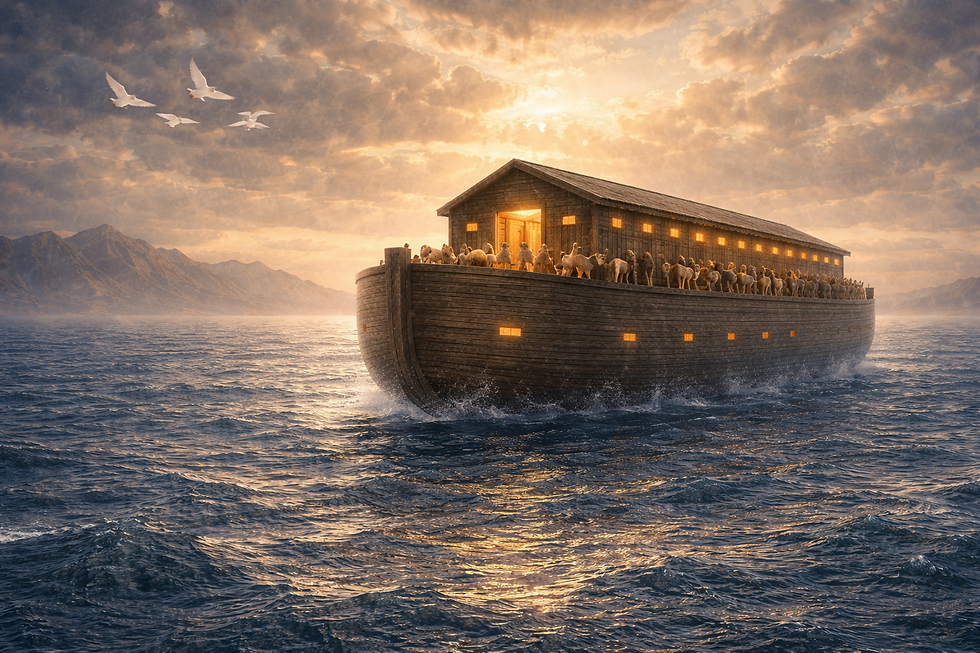
Genesis 7 describes Noah entering the ark with his family and the animals, just as God commanded. The floodwaters come upon the earth, covering even the highest mountains. All living creatures outside the ark perish. The waters prevail for 150 days, but Noah and those with him are kept safe inside the ark.
Key Themes
1. Obedience to God- Noah follows God’s instructions exactly, demonstrating true faith.
2. God’s Judgment on Sin- The flood shows that God takes sin seriously and will judge it.
3. Salvation Through the Ark- The ark becomes the only place of safety, symbolizing rescue.
4. God’s Faithfulness- God keeps His promise to preserve Noah and the animals.
5. Separation Between Righteous and Wicked- Those inside the ark are saved, while those outside face judgment.
Genesis 7 Explained: Verse-by-Verse Breakdown
Verses 1-5 God tells Noah to enter the ark with his household because he is righteous. Noah obeys completely.
Verses 6-10 Noah is 600 years old when the flood begins. The animals enter the ark in pairs as commanded.
Verses 11-12 The flood begins with water bursting from the "fountains of the deep" and rain falling for forty days and nights.
Verses 13-16 Noah, his family, and the animals enter the ark. God Himself shuts the door, sealing them inside.
Verses 17-20 The waters rise, lifting the ark above the earth and covering even the highest mountains.
Verses 21-23 All living creatures outside the ark perish. Humanity and land animals are wiped out.
Verse 24The waters prevail on the earth for 150 days.
Deep Insight
Genesis 7 emphasizes that God’s patience has a limit. For generations, humanity had become increasingly corrupt, and now judgment comes fully and decisively.
The detail that God shuts the ark’s door is significant. It shows that salvation is ultimately in God’s hands. There is a moment when opportunity ends and judgment begins.
The flood is both literal and symbolic. It represents cleansing - removing corruption from the earth. At the same time, it points forward to a greater spiritual truth: salvation comes through God’s provision alone.
The ark itself is a powerful image. It had one door, one way in. This reflects the truth later revealed in Jesus Christ - that there is one way to be saved.
Tough Questions Answered
How did all those animals fit on the ark?
The ark was far larger than people often picture. At roughly 450 feet long, 75 feet wide, and 45 feet high, it had the volume of hundreds of railroad stock cars. Scripture says the animals came in kinds, not individual species, and a "kind" is broader than a modern species, closer to a family grouping from which later variation developed. That means far fewer animals than the millions of species today. Most land animals are small, the average size being smaller than a sheep, and many could have been young. There was ample room for the animals, their food, and Noah's family. The chapter presents this not as a fairy tale but as a feat of obedience and divine provision.
See also: Genesis 6:15, Genesis 7:14-16, Genesis 1:24-25
What does it mean that "the Lord shut him in" (Genesis 7:16)?
It is one of the tenderest details in the flood account. After Noah did all his part, gathering the animals and entering the ark, God Himself closed the door. The salvation of Noah's family did not finally rest on Noah's strength to seal the ark or hold the door against the rising water. It rested on God. The shut door marks the moment grace and judgment divide: those inside are secured by God, those outside are left to the flood. It pictures the gospel, where safety comes not from our effort but from God enclosing His people in the refuge He provided, which the New Testament connects to salvation in Christ.
See also: Genesis 7:16, John 10:28-29, 1 Peter 3:20-21
Application (Real Life)
Genesis 7 challenges us in practical ways:
Take God’s warnings seriously - His words are trustworthy and true.
Obedience matters - Noah’s actions saved his family.
Salvation is available, but not forever - There is a time to respond.
God provides a way out - Even in judgment, He offers rescue.
Faith requires action - Noah didn’t just believe; he obeyed.
This chapter calls us to respond to God with urgency and trust.
Apologetics Angle
Genesis 7 supports key doctrines:
God’s Justice- The flood demonstrates that God is holy and must judge sin.
God’s Mercy- Noah’s salvation shows that God provides grace even in judgment.
Foreshadowing of Christ- The ark represents Jesus. Just as Noah was saved through the ark, believers are saved through Christ alone.
The Trinity (Implied)- God’s role as judge and savior reflects His complex nature, fully revealed later as Father, Son, and Spirit.
Cross References
Matthew 24:38-39 - People were unaware until the flood came, just like the end times.
Hebrews 11:7 - Noah’s obedience is an act of faith.
2 Peter 3:6 - The world was destroyed by water because of sin.
John 10:9 - Jesus is the door through which we are saved.
1 Peter 3:20-21 - The ark symbolizes salvation.
Isaiah 54:9 - God recalls the days of Noah as a covenant reference.
Genesis 7 Explained: Conclusion
Genesis 7 is a sobering reminder of God’s judgment but also a powerful testimony of His saving grace. While the flood destroys a corrupt world, it also preserves a faithful remnant. The chapter points forward to the ultimate salvation found in Christ, reminding us that God always provides a way for those who trust Him.


Comments