

Joel 1 Explained - The Locust Plague and a Call to Mourn
- Jun 25
- 4 min read
Introduction
Joel 1 Explained opens with devastation no one could ignore. A swarm of locusts stripped the land bare and left a nation in shock.
But the disaster was a megaphone. God was speaking through the ruin.
Summary
An invasion of locusts has destroyed everything. Crops, vineyards, fields, and harvests are gone. The prophet Joel calls the whole nation to pay attention. The old have never seen anything like it, and they must tell their children. Joel summons different groups to mourn. Drunkards weep over lost wine. Farmers grieve ruined fields. Priests lament because there is no grain or drink to offer at the temple. The devastation is total, and even the animals cry out to God. Joel sees this catastrophe as a warning. The day of the Lord is near. He calls the people to declare a holy fast and cry out to God. This is a chapter about hitting rock bottom and looking up.
Key Themes
Total devastation. The locusts left nothing behind across every part of life.
A call to remember. This disaster was so severe it had to be told to future generations.
Universal mourning. Joel summons every group, even the priests and the land itself, to grieve.
The day of the Lord. The plague was a preview of a greater coming judgment.
Turn to God. The right response to ruin is repentance and crying out to the Lord.
Joel 1 Explained: Verse-by-Verse Breakdown
Verses 1-4: An Unprecedented Disaster
Joel calls the elders and all the people to listen. Has anything like this ever happened in their days or their fathers' days? Tell your children, and let them tell theirs.
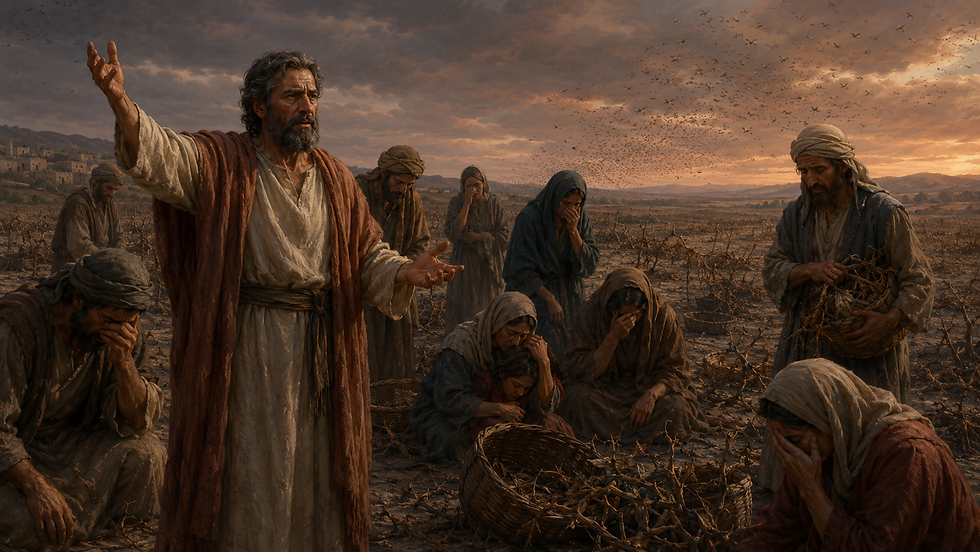
Then he describes the locusts in waves. What one swarm left, another devoured. The destruction was layered and complete. Nothing green survived.
Verses 5-12: A Land in Mourning
Joel addresses group after group. Wake up, drunkards, and weep, for the wine is cut off. A nation has invaded the land, powerful and without number, with teeth like a lion.
The vines are dried up, the fig trees withered. The farmers are ashamed and the vinedressers wail. The grain is destroyed, the wine dried up, the oil gone. Joy has withered away from the people.
Verses 13-15: A Call to the Priests
Joel turns to the priests. Put on sackcloth and lament. The grain offering and drink offering are cut off from the house of God. There is nothing left to bring before the Lord.
He commands a holy fast and a solemn assembly. Gather the elders and all the people and cry out to the Lord. Then comes the warning. Alas for the day, for the day of the Lord is near.
Verses 16-20: Even the Animals Cry
The food is cut off before their eyes. Joy and gladness are gone from the house of God. Seeds shrivel, barns lie in ruins, and granaries are broken down.
Even the beasts groan. The herds wander in confusion because there is no pasture. The flocks suffer. Joel ends with his own prayer. To You, O Lord, I cry. Fire has devoured the pastures and flames have burned the trees.
Deep Insight
Joel does something bold. He refuses to treat the locust plague as random bad luck. He reads it as a message from God meant to turn hearts back.
That is a hard truth our culture resists. We want disasters to be meaningless so they make no claim on us. Joel insists that God can use loss to get our attention when comfort never could.
Notice that even the priests had nothing to offer. When the worship of God grinds to a halt, that is the deepest crisis of all. The empty altar mattered more than the empty barn.
Tough Questions Answered
Did God send the locusts as punishment?
Joel presents the plague as a divine warning meant to lead the people to repentance. Whether God directly sent it or used a natural event, the message is the same. God was calling a complacent people back to Himself before a greater judgment arrived.
Amos 4:9 - God describes using blight and locusts to call Israel back.
Is it fair to read a natural disaster as a spiritual message?
Joel does not claim every disaster is a specific punishment. He does claim that suffering can wake us up to our need for God. The locusts stripped away every false comfort and left only one place to look. Up. That is a mercy disguised as a catastrophe.
Romans 8:28 - God works all things for good for those who love Him.
Application (Real Life)
When everything is stripped away, let it drive you to God, not despair.
Do not waste your suffering. Ask what God may be saying through it.
Take sin and repentance seriously before crisis forces the issue.
Guard your worship. An empty altar is a worse loss than an empty barn.
Simple closing test: When hard times hit, is your first instinct to turn to God or to numb the pain?
Apologetics Angle
Joel describes a locust plague with vivid, accurate detail. Ancient and modern accounts of locust swarms in the Near East confirm exactly this kind of layered, total destruction. The text reflects real conditions, not invented drama.
More importantly, Joel introduces the day of the Lord, a theme the New Testament picks up and applies to Christ's return. The Bible's prophets speak with one voice across centuries about judgment and redemption. That unified message, written by many hands over many years, is part of the evidence that one Author stands behind it.
Cross References
Amos 4:9 - God using locusts and blight to call His people back.
Joel 2:25 - God's promise to restore the years the locusts ate.
2 Peter 3:10 - The day of the Lord will come like a thief.
James 4:8-10 - Draw near to God and humble yourselves before Him.
Joel 1 Explained: Conclusion
Joel 1 Explained is a chapter of ruin that becomes a call to return. The locusts took everything, but they could not silence the voice of God.
Rock bottom is often where people finally look up. Joel knew that, so he turned grief into prayer.
The gospel takes this further. In Christ, the worst devastation, the cross, became the doorway to restoration. When everything is stripped away, Jesus remains. Cry out to Him, and you will find the day of the Lord is also a day of mercy.

Comments