
Exodus 38 Explained - The Altar, the Basin, and the Cost of Worship
- Jun 30
- 6 min read
Introduction
Exodus 38 is a chapter about sacred construction, divine measurement, and costly devotion. Every nail, every socket, every basin in this chapter was paid for by someone who understood that worship is never free.
The tabernacle was not a symbol of Israel's wealth. It was a symbol of God's worth.
Summary
Exodus 38 records the completion of three key elements of the tabernacle courtyard: the bronze altar of burnt offering, the bronze basin for ceremonial washing, and the outer courtyard itself with its posts, curtains, and gate. The chapter closes with a precise accounting of all the gold, silver, and bronze used in the tabernacle's construction. This was not just a building report. It was a testimony to the generosity of a redeemed people and the faithfulness of craftsmen doing holy work under God's instruction.
Key Themes
Worship has a cost. The materials were not free. They were given by people who had been set free.
Atonement is the foundation. The silver used in the tabernacle came from the ransom price paid by every Israelite man. Grace is costly.
Purification precedes service. The bronze basin stood between the altar and the tent. You had to be clean to approach.
God is a God of order. The courtyard dimensions, the post spacing, the curtain measurements, all of it was exact.
Accountability in worship. The final inventory was not an afterthought. It was a public record of stewardship.
Exodus 38 Explained: Verse-by-Verse Breakdown
Verses 1-7: The Bronze Altar
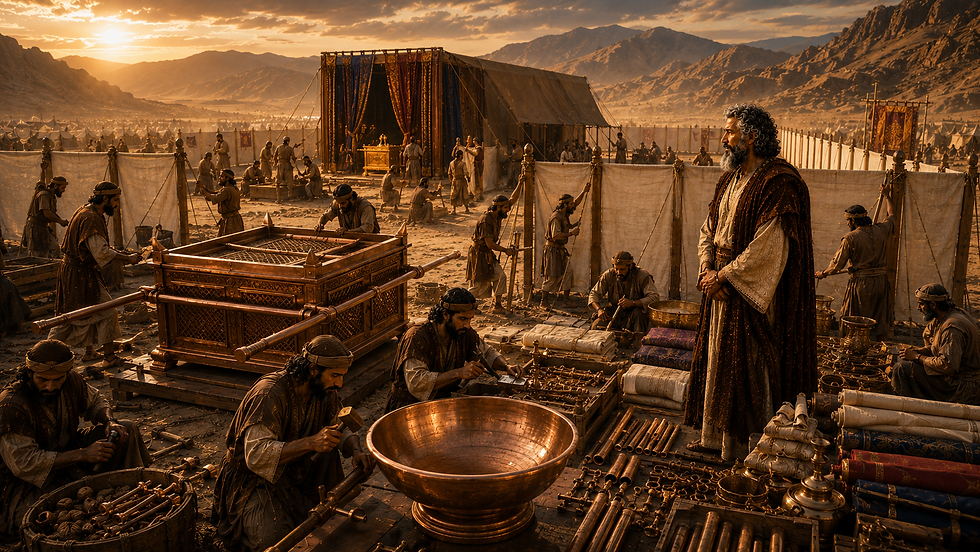
Bezalel built the altar of burnt offering from acacia wood overlaid with bronze, square, five cubits by five cubits and three cubits high, with bronze horns at each corner, a bronze grating, bronze utensils, and rings for the carrying poles.
This was the first thing you saw when you entered the tabernacle courtyard. Before anything else, you faced the altar. Before prayer, before the presence of God, the blood. This is the gospel in architecture. There is no access to God without atonement.
Verse 8: The Bronze Basin and the Women's Mirrors
The bronze basin and its stand were made from the mirrors of the women who served at the entrance of the tent of meeting. This single verse is remarkable. These women gave something personal. Something they could have kept. Their mirrors, the tools of personal appearance, became the tool of priestly purification. Vanity turned into holiness. Self-focus turned into service.
The priests washed their hands and feet at this basin before serving. Cleansing was not optional. God commanded it. No priest approached the altar or the tent without being washed first.
Verses 9-20: The Courtyard
The courtyard ran 100 cubits on the north and south sides and 50 cubits wide on the east and west, enclosed by fine twined linen on bronze posts with silver hooks and bands. The gate, on the east, was 20 cubits wide, woven of blue, purple, and scarlet yarn.
The courtyard was visible. Public. The gate was wide. Any Israelite could approach. But the closer you got to God's dwelling, the more restricted access became. The courtyard. The Holy Place. The Most Holy Place. Only the high priest once a year with blood. This progression points to the work of Christ, who tears the veil and opens the way.
Verses 21-31: The Inventory of Materials
Moses commanded that a record be kept. Ithamar son of Aaron supervised it. Bezalel son of Uri built everything. Oholiab son of Ahisamak assisted him.
The totals were staggering: 29 talents and 730 shekels of gold, 100 talents and 1,775 shekels of silver from the census tax (a half-shekel from each of 603,550 men), and 70 talents and 2,400 shekels of bronze. The 100 talents of silver were cast into the 100 bases of the sanctuary. Each man's atonement payment became a foundation stone.
Deep Insight
The silver census tax reveals something profound about grace. Every man paid the same amount. Rich or poor. Half a shekel. No one paid more because they had more. No one paid less because they had less. Before God, all men are equal in their need for atonement.
That silver became the foundation sockets of the whole structure. The house of God literally rested on ransom money. It is a picture of the New Testament reality: our entire access to God rests on one payment, the atoning death of Jesus Christ.
The women's mirrors becoming the bronze basin is also striking. These women chose to give up self-reflection so priests could be cleansed. Jesus gave up far more so we could be made clean. The giving in Exodus 38 echoes the giving of Calvary.
Tough Questions Answered
Q: Why does God need an elaborate tabernacle? Couldn't He just be present anywhere?
God is omnipresent, but the tabernacle was not about limiting God. It was about giving sinful people a structured, blood-covered path to approach a holy God. It was mercy made physical. Psalm 99:1 says He is enthroned above the cherubim. He chose to manifest His glory there as a gift to His people, not out of necessity. The structure taught Israel what holiness requires.
Q: Why does the chapter include such detailed financial records?
Accountability matters in God's house. Moses did not handle the contributions vaguely. Every ounce was counted and reported. 2 Corinthians 8:21 says, 'For we aim at what is honorable not only in the Lord's sight but also in the sight of man.' The inventory models financial integrity for all who serve the church. It also proves the offering was real. These were not mythological gifts. They were counted, named, and recorded.
Q: Who were the women at the entrance to the tent of meeting?
Scripture does not give a full description of their role, but they served at the entrance. 1 Samuel 2:22 references similar women at Shiloh. These women served in some organized capacity near the tabernacle. What we know from Exodus 38:8 is that they were devoted enough to give up their mirrors, personal possessions of real value, for the worship of God. Their sacrifice was honored by being named in Scripture.
Application (Real Life)
Give intentionally. The Israelites gave specific materials for a specific purpose. Random, unthoughtful giving is not the model here. Give where God is building.
Give personally. The women gave their mirrors. Not surplus. Something that cost them. 2 Corinthians 9:7 says God loves a cheerful giver, but cheerful giving is not cheap giving.
Pursue cleansing before service. The basin was not optional. Christians are called to confess sin, to be washed by the Word (Ephesians 5:26), before entering ministry. Unclean hands in sacred service dishonor God.
Be accountable with what belongs to God. Every church and ministry should handle finances with the transparency that Moses modeled here.
Remember who you were redeemed from. The men's ransom silver built the foundation. Every time Israel walked into the courtyard, they were standing on the price of their own rescue. Never forget the cost of your freedom.
Personal test: What is one thing you are holding onto that God may be calling you to give for His purposes?
Apologetics Angle
Critics sometimes argue the detailed tabernacle accounts are post-exilic inventions written long after Moses. But the internal evidence pushes back. The materials listed (acacia wood, fine linen, bronze from mirrors) all fit what was available in the Sinai region and ancient Egypt, and the census of 603,550 men matches Numbers 1:46, showing consistency across two separate books. The accounting is too specific to be myth. Myths do not give silver weights down to the shekel.
The tabernacle's portable, tripartite design also matches ancient Near Eastern sacred space, and tent shrines from the 15th-14th centuries BC have been found in Midian and Canaan. The account fits the world it claims to describe.
The deeper point is this: the tabernacle was designed to point to Jesus. The altar, basin, veil, bread, and lampstand all find their fulfillment in Christ. A fabricated document would not accidentally build a perfect prophetic picture of the gospel. It is too theologically precise to be accidental.
Cross References
Hebrews 9:1-5 – The writer of Hebrews describes the tabernacle furnishings as a shadow of the heavenly sanctuary where Christ now serves.
John 1:14 – 'The Word became flesh and dwelt among us.' The Greek word for 'dwelt' is the same root as tabernacled. Jesus is the fulfillment of what the tabernacle pointed to.
Revelation 21:3 – The final state of creation is described as God dwelling, tabernacling, with His people. Exodus 38 is the preview. Revelation 21 is the finale.
Numbers 1:46 – Confirms the 603,550 men counted in the census, validating the silver total recorded in Exodus 38:26.
2 Corinthians 8:21 – Paul's call for financial accountability in ministry reflects the same principle Moses applied when ordering the tabernacle inventory.
Ephesians 5:26 – Christ sanctifies His church, washing her by the water of the Word. The bronze basin's cleansing is fulfilled in the gospel's sanctifying work.
Exodus 38 Explained: Conclusion
Exodus 38 Explained is a chapter of sacred accounting, where every ounce of metal tells the story of a people who were ransomed, washed, and given access to God.
The altar says no one approaches a holy God without blood. The basin says no one serves a holy God without cleansing. The courtyard says the way is open, but there is only one gate. And the inventory says nothing given for God's glory is wasted or forgotten.
Jesus is the altar that satisfied divine justice, the basin that cleanses every sin, and the gate through which we enter. The tabernacle was never the destination. It was the arrow, pointing to the One who tears the veil, absorbs the wrath, and invites every sinner to draw near.


Comments