
Exodus 39 Explained - The Priestly Garments and the Completion of God's Holy Work
Introduction
Exodus 39 is a chapter of finished work and faithful obedience. The priestly garments are made exactly as God commanded.
It can read like an inventory list. But every thread carries meaning. The repeated phrase, as the Lord commanded Moses, is the heartbeat of the chapter. This is what holy worship looks like when people obey God down to the detail.
Summary
The craftsmen make the holy garments for Aaron and his sons: the ephod, the breastpiece with its twelve stones, the robe, the tunics, the turban, and the golden plate engraved Holy to the Lord. Each item is made precisely as God instructed. The chapter ends with all the work of the tabernacle completed and brought to Moses, who inspects it, sees it was done as commanded, and blesses the people.
Key Themes
Obedience to detail: Everything done as the Lord commanded Moses.
Holiness: The garments set the priests apart for God.
Representation: The high priest carries the names of the tribes before God.
Completed work: The labor is finished and inspected.
Blessing: Faithful work ends in blessing.

Exodus 39 Explained: Verse-by-Verse Breakdown
Verses 1-7: The Ephod
The craftsmen make the ephod of gold, blue, purple, and scarlet yarn. They hammer gold into thin sheets and cut it into threads to work into the fabric. Two onyx stones engraved with the names of Israel's sons are set on the shoulder pieces as stones of remembrance.
Verses 8-21: The Breastpiece
The breastpiece holds twelve precious stones in four rows, each engraved with the name of a tribe. It is bound to the ephod with gold chains and blue cord so it sits over the high priest's heart. Israel is carried close to the heart of the one who represents them before God.
Verses 22-31: The Robe, Tunics, and Holy Plate
The robe of the ephod is woven blue, with pomegranates and golden bells around the hem. They make tunics, the turban, and the sash. A plate of pure gold is engraved Holy to the Lord and fastened to the turban.
Verses 32-43: The Work Completed and Blessed
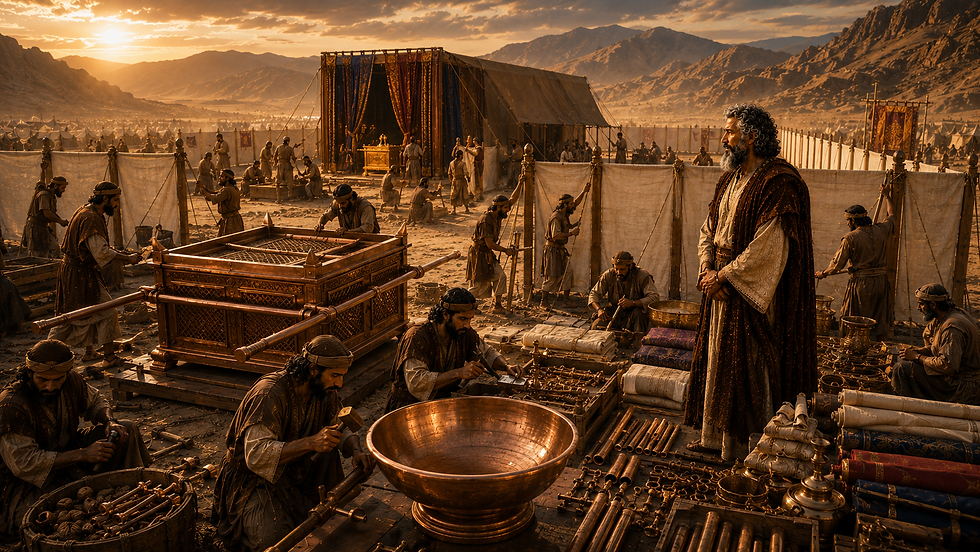
All the work is finished. The people do everything just as the Lord commanded Moses. They bring it all to Moses, who inspects every piece, sees it was done exactly as commanded, and blesses them.
Deep Insight
Count how many times the chapter says, as the Lord commanded. It appears again and again, like a drumbeat. This is not dull repetition. It is the point. Worship is not about creative improvement on God's instructions. It is about faithful obedience to them. The high priest wore the names of the tribes on his shoulders and over his heart, carrying the people into God's presence. That is a picture of what Christ now does for us, bearing our names before the Father.
Tough Questions Answered
Why does the Bible spend so much space on garment details?
Because the details teach reverence. God cares how He is approached. The precision shows that holiness and worship are not casual, and it prepares the way for the perfect High Priest to come. (Exodus 39:43, Hebrews 8:5)
What do the names on the shoulders and heart mean?
The high priest represented all twelve tribes before God, carrying them on his shoulders, a place of strength, and over his heart, a place of love. It pictures intercession, which Christ fulfills for His people. (Exodus 39:7, Hebrews 7:25)
What does Holy to the Lord on the gold plate signify?
It marked the high priest, and through him the worship of Israel, as set apart for God. It points to the holiness God requires and ultimately provides in Christ. (Exodus 39:30, 1 Peter 1:16)
Application (Real Life)
Obey God in the details, not just the big decisions.
Do your work as worship, with care and faithfulness.
Remember that Christ carries your name before the Father.
Treat worship as holy, not casual.
Finish what God gives you to do, and trust Him with the result.
Simple test: Are you obeying God fully, or only in the parts that are convenient?
Apologetics Angle
Exodus 39 reflects a faith obsessed with one question: did we do exactly what God said? That refusal to improvise points to a God who reveals His will precisely and expects it to be honored. The elaborate priesthood also exposes a problem the chapter cannot solve. The garments are external. They cover, but they cannot cleanse the heart. That gap is the very thing the New Testament says Christ fills, the true High Priest who makes His people holy from the inside. The shadow in Exodus only makes sense when the substance arrives.
Cross References
Exodus 28:1-2 - The original command for the priestly garments.
Hebrews 7:25 - Christ always lives to intercede for us.
Hebrews 8:5 - The earthly sanctuary a copy of the heavenly.
1 Peter 2:9 - A royal priesthood, a holy nation.
Revelation 1:13 - Christ pictured in priestly garments.
Exodus 39 Explained: Conclusion
Exodus 39 Explained is a chapter of faithful hands doing holy work. Every garment made as the Lord commanded, every name carried before God, all the work finished and blessed. It points beyond itself to Jesus, our great High Priest, who carries our names before the Father and makes us truly holy. The shadow is beautiful. The substance is better.

Comments