
Exodus 37 Explained - Building the Ark, the Table, the Lampstand, and the Altar of Incense
Introduction
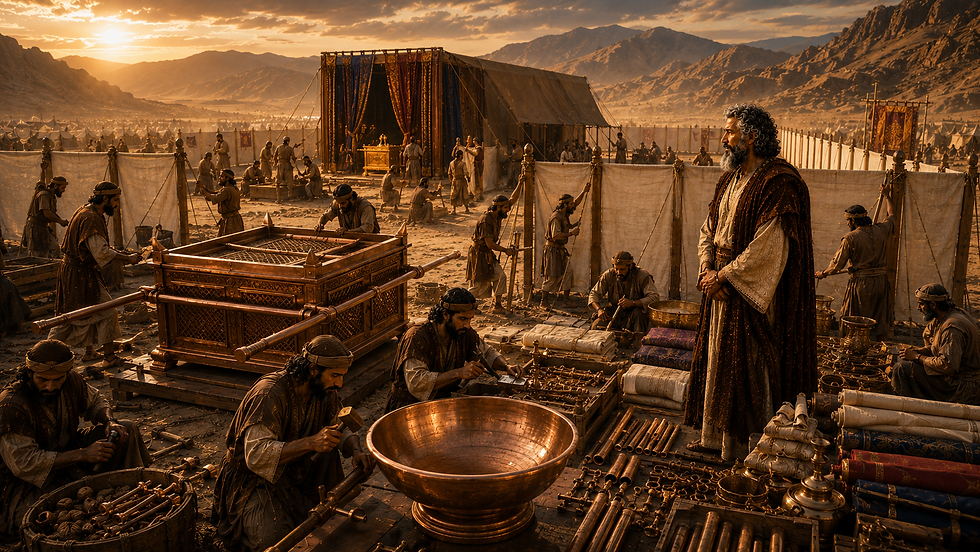
Exodus 37 is where sacred blueprints become sacred objects. God gave the design. Now Bezalel builds it.
This chapter records the construction of the four most holy furnishings of the Tabernacle. Every detail matters. Every measurement means something. This is not decorative religion. This is God setting the terms for how He will be approached.
Summary
Exodus 37 follows master craftsman Bezalel as he constructs the Ark of the Covenant, the Table of Showbread, the Golden Lampstand, and the Altar of Incense, all exactly as God commanded Moses. Each object is built with precise materials, specific dimensions, and intentional design. Nothing is improvised. Nothing is left to human preference. This chapter is worship expressed through obedience to the blueprint.
Key Themes
Obedience to God's exact instructions
The holiness of God and the seriousness of access to Him
The craftsmanship God calls out and equips
Every object as a shadow of Christ
Worship requiring both heart and precision

Exodus 37 Explained: Verse-by-Verse Breakdown
Verses 1-9: The Ark of the Covenant
Bezalel builds the Ark out of acacia wood, 2.5 cubits long (3 ft 9 in), 1.5 cubits wide (2 ft 3 in), and 1.5 cubits tall (2 ft 3 in)
Overlaid inside and out with pure gold. A gold molding around it
Four gold rings, two on each side, for the poles used to carry it
The poles are also acacia wood overlaid with gold and they stay in the rings permanently
The atonement cover (mercy seat) is made of pure gold, matching the Ark's dimensions: 2.5 cubits long (3 ft 9 in) by 1.5 cubits wide (2 ft 3 in)
Two cherubim hammered from gold, one on each end, face each other with wings spread over the cover
The Ark is the most sacred object in Israel. It holds the tablets of the Law. God said He would meet with Moses above the mercy seat, between the cherubim (Exodus 25:22). This is not furniture. It is the meeting place between a holy God and a sinful people, only accessible through atonement.
Verses 10-16: The Table of Showbread
Built from acacia wood, 2 cubits long (3 ft), 1 cubit wide (1 ft 6 in), and 1.5 cubits tall (2 ft 3 in)
Overlaid with pure gold with a gold molding and rim
Four gold rings for the carrying poles
All plates, dishes, pitchers, and bowls for drink offerings are made of pure gold
Twelve loaves of bread were placed on this table weekly, representing the twelve tribes of Israel before God (Leviticus 24:5-9). God was providing. God was sustaining. The table in His presence is not empty.
Verses 17-24: The Golden Lampstand (Menorah)
Hammered from one talent of pure gold (roughly 75 lbs)
A central shaft with six branches, three on each side
Each branch has cups shaped like almond blossoms with buds and flowers
Seven lamps total, with wick trimmers and trays all of pure gold
The lampstand is hammered, not cast. It requires skill, pressure, and shaping. It burns continually (Exodus 27:20). In a Tabernacle with no windows, this is the only light. God is the source of light in His own house.
Verses 25-29: The Altar of Incense
Built from acacia wood, 1 cubit long (1 ft 6 in) by 1 cubit wide (1 ft 6 in), and 2 cubits tall (3 ft)
Overlaid with pure gold, including its top, sides, and horns
A gold molding around it and two gold rings on opposite sides for carrying
Bezalel also makes the anointing oil and the pure fragrant incense
This altar stands just outside the veil in front of the Ark. Incense is burned on it every morning and evening (Exodus 30:7-8). The smoke of incense represents the prayers of God's people rising before Him (Psalm 141:2, Revelation 8:3-4).
Deep Insight
Every object in Exodus 37 follows the same pattern: God commanded it in Exodus 25-30, and now Bezalel executes it exactly. Bezalel is filled with the Spirit of God (Exodus 31:3), yet the Spirit leads him into precise obedience, not improvisation.
This confronts a common assumption that Spirit-led worship is spontaneous and unstructured. The most Spirit-filled craftsman in the Old Testament builds exactly what God said, down to the cubit. The Spirit and the Word work together. Always.
Each object also points forward:
The Ark points to Christ as the meeting place between God and man (Romans 3:25, where "propitiation" echoes the mercy seat)
The Table points to Christ as the Bread of Life (John 6:35)
The Lampstand points to Christ as the Light of the World (John 8:12)
The Altar of Incense points to Christ as our intercessor (Hebrews 7:25), whose prayers and ours rise before the Father
Exodus 37 is a chapter full of Christ, hiding in gold and acacia wood.
Tough Questions Answered
Q: Why is the same information repeated from Exodus 25-30?
Exodus 25-30 is the divine blueprint. Exodus 35-40 is the record of completion. The repetition is intentional. It confirms that Israel obeyed exactly. God said it. They did it. That parallelism is the theological point. Full obedience to the full command.
Q: Does any of this still apply to Christians today?
Not ceremonially. The sacrificial system and the Tabernacle rituals are fulfilled in Christ (Hebrews 9-10). But the principle stands. We approach God on His terms, through the one Mediator He has provided (1 Timothy 2:5). The Tabernacle taught Israel that God is holy and access to Him requires atonement. The cross is the fulfillment of that lesson. Christians still need that truth.
Application (Real Life)
Obedience to God's Word is not creative. It is faithful. Stop looking for a more comfortable version of what God has said
The work God calls you to is worth doing with excellence. Bezalel did not cut corners on the things of God
Every time you open your Bible and pray, you are doing what the Tabernacle pointed to. Drawing near to God through Christ
The Spirit of God leads people into the Word of God, not away from it. Be suspicious of any "leading" that contradicts Scripture
Consider how you approach God in worship. Is it on His terms or yours?
Simple test: When you worship, who is setting the terms? You or God?
Apologetics Angle
Skeptics point to the repetition in Exodus 35-40 as evidence of clumsy editing or multiple stitched-together sources, the claim behind the Documentary Hypothesis (JEDP). But this repetition makes clear literary and theological sense. Ancient Near Eastern writing commonly used a "command and execution" pattern, where a divine instruction is followed by a verbatim record of its fulfillment. It is a deliberate device confirming total obedience, not a seam between conflicting authors.
The repetition answers one question: did Israel obey? Yes, exactly, and the text proves it by matching command to completion. The Tabernacle itself also supports the historical credibility of the Exodus. Its materials, portable design, and construction methods fit what we know of the ancient Near East in that era, details hard to fake from a later period.
Cross References
Exodus 25:10-22 - God's original command for the Ark
Exodus 25:23-30 - God's original command for the Table
Exodus 25:31-40 - God's original command for the Lampstand
Exodus 30:1-10 - God's original command for the Altar of Incense
Exodus 31:1-5 - God calls and fills Bezalel with His Spirit
Leviticus 24:5-9 - The Showbread and its weekly renewal
Psalm 141:2 - Incense as a symbol of prayer
Romans 3:25 - Christ as the propitiation, fulfilling the mercy seat
John 6:35 - Christ as the Bread of Life, fulfilling the Table
John 8:12 - Christ as the Light of the World, fulfilling the Lampstand
Hebrews 7:25 - Christ as our interceding High Priest, fulfilling the Altar of Incense
Hebrews 9:1-14 - The earthly Tabernacle as a shadow of the heavenly reality
Revelation 8:3-4 - Incense and the prayers of the saints before God's throne
Exodus 37 Explained: Conclusion
Exodus 37 Explained is a chapter of faithful hands doing holy work.
Bezalel did not redesign the Ark or suggest a better lampstand. He built what God said, the way God said to build it, and the Spirit of God powered every strike of the hammer.
These objects were never ends in themselves. They were pointers. Jesus is the Ark where wrath and mercy meet, the Bread that never runs out, the Light darkness cannot extinguish, and the intercessor whose prayers never go unanswered.
Exodus 37 is not a furniture catalog. It is a chapter-long prophecy of Christ, written in wood and gold centuries before Bethlehem. Read it that way. Worship accordingly.

Comments