
Exodus 12 Explained - The Passover and the Exodus Begins
Introduction
Exodus 12 institutes the Passover, the night Israel is born as a free nation. When I see the blood, I will pass over you.
This is one of the most important chapters in the Bible. God establishes the Passover, the lamb is slain, the blood is applied, and the firstborn of Egypt die. At last Pharaoh lets Israel go. The whole gospel is foreshadowed here.
Summary
God instructs Israel to begin a new calendar and to keep the Passover. Each household takes a lamb without blemish, kills it at twilight, and puts its blood on the doorposts. They eat it roasted with unleavened bread and bitter herbs, dressed and ready to leave. That night the Lord strikes every firstborn in Egypt, but passes over the houses marked by blood. A great cry rises in Egypt, and Pharaoh finally drives Israel out. The people leave with the plunder of Egypt, and God commands them to keep the Passover and the Feast of Unleavened Bread forever as a memorial.
Key Themes
The Passover lamb: A lamb without blemish slain for each house.
Salvation by blood: The blood on the door brings deliverance.
Judgment and redemption: Death passes over the covered.
A memorial forever: Passover to be kept through the generations.
The exodus begins: Israel finally goes free.
Exodus 12 Explained: Verse-by-Verse Breakdown
Verses 1-13: Instructions for the Passover
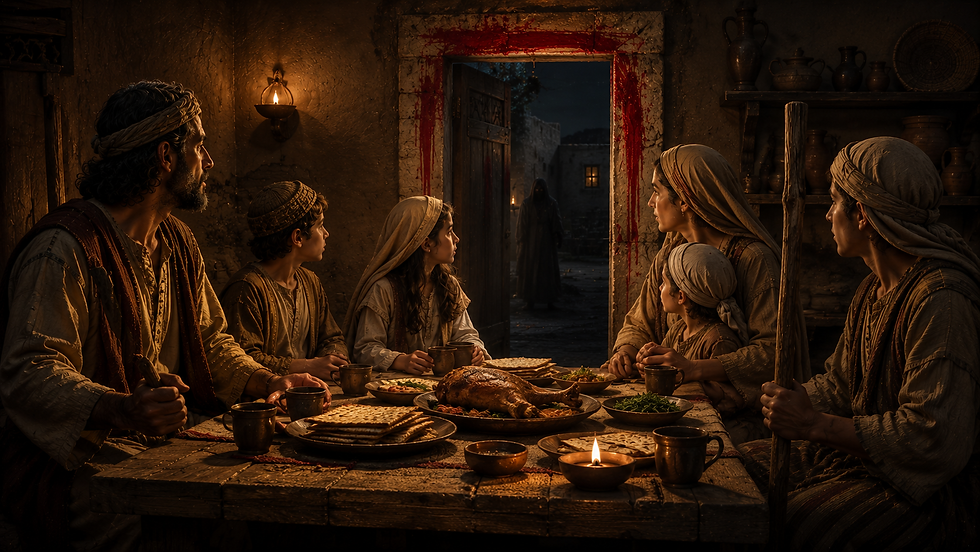
God establishes a new beginning for Israel's calendar. Each household is to take a lamb without blemish on the tenth day, keep it until the fourteenth, then kill it at twilight. They are to put its blood on the doorposts and lintel, and eat it roasted with unleavened bread and bitter herbs. The blood will be a sign, and when God sees it, He will pass over them.
Verses 14-28: The Feast of Unleavened Bread
God commands that Passover be kept as a lasting memorial, along with seven days of eating unleavened bread. The people are to explain its meaning to their children. Moses instructs the elders, and the people bow and worship, then do as the Lord commanded.
Verses 29-36: The Final Plague and the Exodus
At midnight the Lord strikes every firstborn in Egypt. A great cry arises, for there is not a house without someone dead. Pharaoh summons Moses by night and tells them to go. The Egyptians urge them out in haste, and Israel plunders Egypt, receiving silver, gold, and clothing.
Verses 37-51: Israel Leaves Egypt
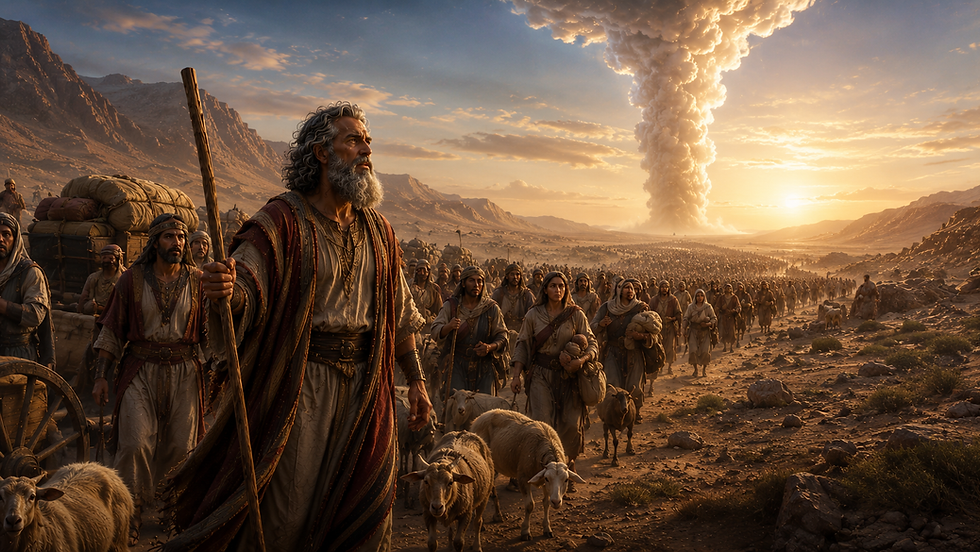
About six hundred thousand men, plus families and a mixed multitude, leave Egypt after four hundred thirty years. God gives further regulations for the Passover, including that no foreigner may eat it unless circumcised. The whole congregation obeys, and the Lord brings them out by their hosts.
Deep Insight
The Passover is the gospel in shadow. A lamb without blemish dies in the place of the firstborn. Its blood, applied to the door, is the difference between life and death. Notice it was not enough for the lamb to die. The blood had to be applied. So it is with Christ. Centuries later, Jesus would be crucified at Passover, and Paul would call Him our Passover lamb. The cross is not effective merely because Christ died, but because His blood is applied to us by faith. When God sees the blood, He passes over. That is the heart of salvation.
Tough Questions Answered
Why did the lamb have to be without blemish?
The spotless lamb pictured purity and pointed forward to Christ, the sinless Lamb of God. Only a perfect substitute could stand in the place of the guilty. The requirement foreshadowed the sinless Savior to come. (Exodus 12:5, 1 Peter 1:19)
How does Passover point to Jesus?
Jesus is our Passover lamb, sacrificed for us. His blood, applied by faith, saves us from the judgment of death, just as the lamb's blood spared Israel's firstborn. He even died during Passover, fulfilling the picture. (Exodus 12:13, 1 Corinthians 5:7)
Why command Israel to keep Passover forever?
So they and their descendants would never forget their redemption and would teach it to their children. Remembering God's saving acts anchors faith across generations and points ahead to the greater redemption in Christ. (Exodus 12:14, Luke 22:19)
Application (Real Life)
Apply the blood of Christ to your life by faith, not just admire it.
Remember and celebrate your redemption regularly.
Teach the next generation what God has done.
Trust that God's judgment passes over those covered by the Lamb.
Live ready to follow God out of bondage.
Simple test: Has the blood of the Lamb been applied to your life, or only admired from a distance?
Apologetics Angle
Exodus 12 establishes the Passover, a festival the Jewish people have continuously observed for over three thousand years, an unbroken historical witness to the events it commemorates. This living tradition is powerful evidence that the exodus was a real, remembered event, not a late invention. Even more striking is the precise foreshadowing of Christ: a spotless lamb, blood that saves, and Jesus crucified at Passover itself. The detailed correspondence between this ancient ritual and the death of Jesus centuries later points to a single divine Author orchestrating redemptive history toward the cross.
Cross References
1 Corinthians 5:7 - Christ our Passover lamb has been sacrificed.
1 Peter 1:19 - The precious blood of Christ, a lamb without blemish.
John 1:29 - Behold the Lamb of God.
Luke 22:19-20 - Jesus institutes the new covenant at Passover.
Hebrews 9:22 - Without the shedding of blood there is no forgiveness.
Exodus 12 Explained: Conclusion
Exodus 12 Explained is the night of redemption. The Passover lamb is slain, its blood applied, and death passes over those who are covered. Israel walks out of Egypt a free people. And every detail points to Jesus, our Passover Lamb, whose blood saves all who trust Him. The lamb's death was not enough by itself, the blood had to be applied. Make sure the blood of Christ covers you.


Comments