
Haggai 2 Explained - The Glory and the Promise
Updated: Nov 11
Introduction
Haggai 2 Explained answers a discouraged people with a stunning promise. The new temple looked small, but God said its glory would be greater than the first.
Three messages encourage the people and point toward the promised King.
Summary
The workers face a painful comparison with the former temple. God gives three dated messages in this chapter. First, He calls the leaders and people to be strong, promises His continuing presence, and announces greater glory and peace (verses 1-9). Next, a priestly ruling exposes the people's uncleanness, and God promises blessing from the stated day even before new fruit appears (verses 10-19). Finally, He promises to make Zerubbabel like His signet ring, a seal associated with authority (verses 20-23). The Christian hope in David's promised King continues through this governor, who appears in Matthew's genealogy of Jesus (Matthew 1:12-16).
Key Themes
Be strong: God's presence gives the discouraged workers courage.
Greater glory: God promises to fill His house with glory; Christians see that promise met in Christ.
Holiness and uncleanness: Sacred work does not automatically cleanse the people's lives.
Promised blessing: God promises this community a changed harvest before it arrives.
The signet promise: God chooses Zerubbabel, a governor in the line leading to Jesus.

Haggai 2 Explained: Verse-by-Verse Breakdown
Verses 1-9: The Latter Glory
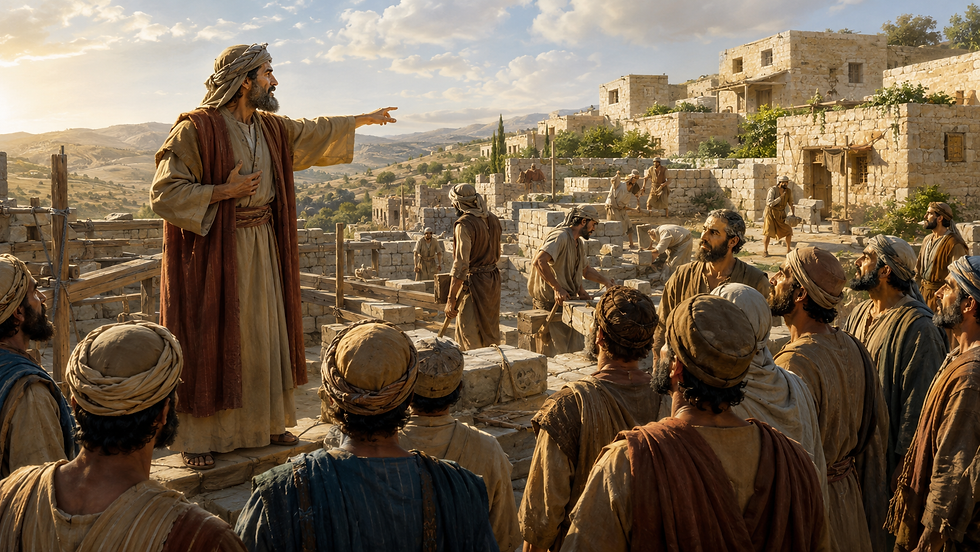
The next message comes on the twenty-first day of the seventh month, less than a month after work resumed (verse 1; Haggai 1:15). God addresses those who remember the house's former glory and find its present appearance unimpressive. He calls Zerubbabel, Joshua, and the people to courage: "Work! For I am with you" (verse 4). His Spirit remains among them, so they need not be afraid.
The glory God promises begins with God Himself: He will shake the nations, and He says He will fill this house with glory (verse 7). He adds, "The latter glory of this house will be greater than the former" (verse 9), and promises peace there. Christians see this greater glory in the presence of Jesus, whom Luke 2:27-32 places in the temple and identifies with God's salvation and Israel's glory.
Verses 10-14: The Lesson on Holiness
The priests are asked about consecrated meat, meat set apart for God, carried in a garment's fold. If the fold touches other food, does that food become holy? They answer no. But if someone made unclean by contact with a corpse touches it, does it become unclean? They answer yes (verses 12-13). The first case concerns food touching the garment's fold, not food touching the holy meat itself.
God applies the ruling to the people and their work: "whatever they offer there is defiled" (verse 14). Sacred activity has not automatically made their conduct clean. The people need to turn to God, not assume that working near holy things settles the condition of their lives.
Verses 15-19: A Promise of Blessing
God calls them to consider their former shortfalls and the stated day when the temple's foundation was laid. The crops have not yet yielded fruit when He promises, "But from this day on, I will bless you" (verse 19). The assurance comes before the changed harvest can be seen.
The promise concerns this community and its land. Their renewed obedience matters, but the words are God's specific assurance to them, not a formula by which every person can earn a better income. They must trust the Lord before the fruit arrives.
Verses 20-23: The Signet Ring
On the same day, a further message addresses Zerubbabel. God announces the overthrow of royal power and promises His servant, "I will make you like My signet ring, for I have chosen you" (verse 23). The promise gives His servant assurance as kingdoms face upheaval.
A signet ring carried its owner's seal and authority. God once said that even if King Coniah were a signet ring on His right hand, He would pull him off (Jeremiah 22:24). Here God uses the same picture as a promise: He will make Zerubbabel like His signet ring (verse 23). Haggai calls Zerubbabel governor, not king (verse 21). Matthew 1:12-16 places this governor in Jesus' family line, carrying the promise toward the coming King.
Deep Insight
God declares that the silver and gold belong to Him (verse 8). The shortage the workers see does not measure His resources. Their task is the work He commands, not finding a way to make Him wealthy.
God assures the workers of His presence before the house is finished (verses 4-5). They are not waiting to attract Him with an impressive completed project. His promise gives them reason to carry on with the work He has commanded.
The holiness lesson still cuts. You cannot make a compromised life holy by adding a little religious activity. Holiness comes from God cleansing the heart, not from good deeds touching a sinful life.
Tough Questions Answered
How was the second temple's glory greater when it looked so plain?
Haggai mentions silver, gold, and the treasures of nations, so why call a visit by Jesus greater glory? The Christian answer is God's presence in Christ, not a claim that building materials are worthless. Luke 2:27-32 brings Jesus into the temple and records Simeon, a worshiper there, identifying Him with God's salvation and glory for Israel. The house receives its deepest honor from the Lord, not from the price of its decoration.
Luke 2:27-32 - Simeon sees the salvation of God in the temple.
What does the signet ring promise to Zerubbabel actually mean?
Zerubbabel is called a governor, so does the ring promise falsely report that he became king? No. God says He has chosen His servant and will make him like His signet; the image expresses His valuing and commissioning him. Matthew 1:12-16 traces the family line onward to Jesus, the promised King. The hope reaches its fulfillment in Christ without a claim that Zerubbabel himself was crowned.
Matthew 1:12-16 - Zerubbabel in the line of Christ.
Application (Real Life)
Be strong when your work for God looks small. He measures differently.
Guard your heart. Sin spreads faster than good intentions can clean it.
Obey God without treating His promises as a way to buy prosperity.
Trust that God keeps His promises across generations, even when you cannot see the end.
Simple closing test: Are you despising a small beginning that God might be using for something far bigger than you can see?
Apologetics Angle
Is Haggai only concerned with a building budget? Hebrews 12:26-28 takes its shaking of earth and heaven as a promise that what can be shaken will be removed, while God's kingdom remains. The Christian hope reaches beyond a construction project to the enduring reign of God.
Hebrews draws a practical conclusion: receive the kingdom with gratitude and worship God with reverence (Hebrews 12:28). Haggai's workers need courage amid unstable kingdoms, not merely a more impressive structure. Their lasting security belongs to God's rule.
Cross References
Luke 2:27-32 - Simeon meets the Lord's salvation inside the temple.
Matthew 1:12-13 - Zerubbabel listed in the genealogy of Jesus.
Hebrews 12:26-28 - God shaking the heavens and earth, quoting Haggai.
Zechariah 4:6 - God tells Zerubbabel that His Spirit, not human force, will accomplish His purpose.
Jeremiah 22:24 - God threatens to remove Coniah, king of Judah, like a signet ring, a contrast with the promise to Zerubbabel.
Haggai 2 Explained: Conclusion
Haggai 2 Explained turns discouragement toward hope. God calls the workers to courage, exposes uncleanness, and promises blessing before new fruit can be seen. The chapter joins renewed work with trust in the Lord who remains among His people.
That glory was Christ. The true temple, the true King, the true presence of God with His people.
Jesus bore our sin at the cross and rose from the dead. Hope rests on Him, not on making every unfinished plan succeed. Follow the promise of glory in verses 6-9 into Luke's account of Jesus at the temple, then examine how His presence answers a hope that cannot be measured by gold alone.
Comments