
Haggai 1 Explained - Consider Your Ways and Rebuild
Updated: Nov 10
Introduction
Haggai 1 Explained is God's wake-up call to a distracted people. The temple sat in ruins while everyone built their own comfortable homes.
One short chapter. One sharp question. Where are your priorities?
Summary
The returned exiles face God's word in the second year of King Darius, with His temple still in ruins. The people say the time is not right to rebuild. Through the prophet Haggai, God confronts their priorities: they live in paneled houses while His house remains neglected. He connects their poor harvests and dwindling returns with that neglect. Zerubbabel the governor, Joshua the high priest, and the people obey. God assures them of His presence and stirs their spirits to begin the work.
Key Themes
Misplaced priorities: Their own houses received attention while God's house lay in ruins.
Consider your ways: God calls the people to examine their choices.
Empty results: God identifies the reason for this community's poor harvests.
Obedience that moves: The leaders and people respond by beginning the work.
God's presence: The Lord assures His people and stirs their spirits.
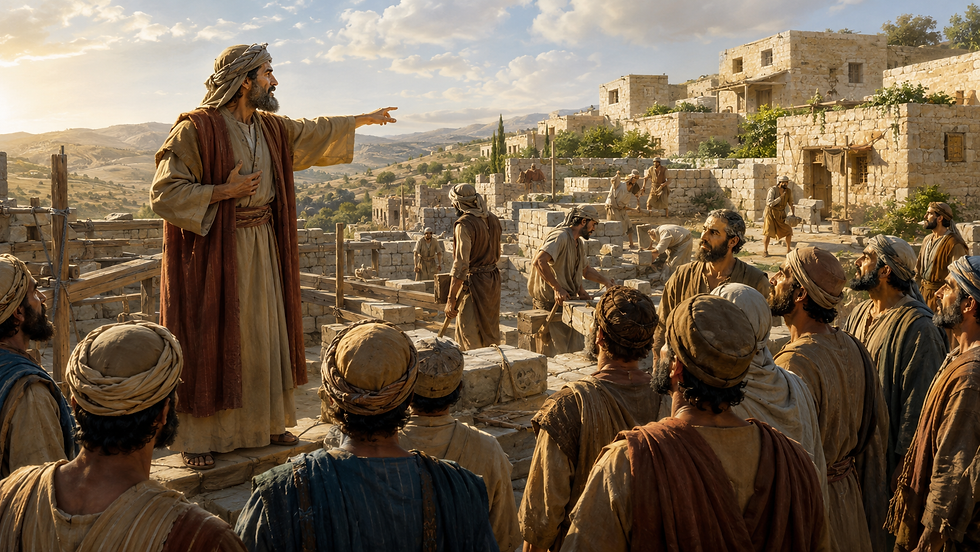
Haggai 1 Explained: Verse-by-Verse Breakdown
Verses 1-2: The Wrong Timing
Haggai delivers God's word to Zerubbabel the governor and Joshua the high priest. The people are saying the time has not come to rebuild the Lord's house. They are not refusing God outright. They are just delaying. Later. Not now. Their delay contradicts the command God now gives.
Verses 3-6: Consider Your Ways
God asks, "Is it a time for you yourselves to live in your paneled houses, while this house lies in ruins?" (verse 4). Their homes are not the problem by themselves; the contrast exposes neglect of His house. His command is, "Consider carefully your ways" (verse 5).
They plant much and harvest little, eat without having enough, and earn wages that do not meet their needs. Verse 6 pictures their earnings going into a pierced bag. Their hardship is real, and God calls them to examine how their choices relate to it.
Verses 7-11: The Reason for the Drought
God repeats the call to examine their ways, then gives concrete work to do: "Go up into the hills, bring down lumber, and build the house" (verse 8). He explains why their expected plenty has dwindled: His house lies in ruins while each person is busy with his own.
God says, "I have summoned a drought" (verse 11). He names its reach across fields, crops, people, animals, and their labor. This drought is not left for the hearers to diagnose by guesswork: God explicitly connects it with their neglect in verses 9-10.
Verses 12-15: The People Obey
Zerubbabel, Joshua, and the remnant obey the Lord and fear Him. Haggai delivers the assurance, "I am with you" (verse 13). The promise concerns the Lord's presence as they respond to His word.
He stirs up their spirits. Twenty-three days after the first message, they begin work on the house of the Lord of hosts. Conviction became action.
Deep Insight
Notice the sequence. God addresses the people through Haggai; they heed His word; He assures them of His presence. Then He stirs their spirits, and they begin the work (verses 12-14). Their response is real, but they are not left to carry out His command without His help.
Haggai's hearers had homes to maintain, but God's house remained in ruins. That is the danger this chapter exposes. You can drift from God without ever deciding to walk away. You just keep saying later until later becomes never.
The warning produces a changed response. The people who had deferred the work hear the Lord's message with reverence and begin to rebuild. The story moves from exposed neglect to shared obedience, rather than ending at the rebuke.
Tough Questions Answered
Was God being selfish for demanding His house be built first?
Requiring hungry people to rebuild His house can sound selfish. No, God is not asking because He needs shelter. He calls them to honor Him, while their paneled houses show that His house alone has been left neglected (verses 4,8). Worship is not a luxury to fit around every private project. The command confronts selective priorities, not the bare need for a home.
Matthew 6:33 - Jesus calls His hearers to seek God's kingdom and righteousness first.
Did God really cause the drought to punish them?
Calling a drought can sound cruel when people are already struggling. Yes, God says He summoned this one (verse 11); the chapter connects it to the neglect He names and records the people returning to the work. That does not make every illness or failed harvest proof of a particular sin. Here the diagnosis comes from God's stated word, and His next message assures the responding people of His presence.
Hebrews 12:6,10-11 - God's fatherly discipline aims at His children's good and a life shaped by righteousness.
Application (Real Life)
Check where your time and money actually go. That is your real priority list.
Stop saying later to God. Delay is still disobedience.
When life feels empty despite hard work, ask what you have put first.
Obey quickly. The people moved in 23 days, not 23 years.
Simple closing test: If someone tracked your calendar and bank account for a month, would they conclude God comes first?
Apologetics Angle
Does a prophetic message have to float outside history? Haggai gives a year of the king's reign, a month, a day, and the names and offices of its hearers (verses 1,15). Ezra 5:1-2 also names Haggai, Zerubbabel, and the renewed work. A precise date alone does not prove that a message came from God, but these passages put the claim in a concrete public setting.
The account identifies both delay and a dated change in conduct: the people begin the very work they had postponed. Its claim is not merely that they felt inspired, but that named leaders and a community acted on a particular message. Haggai places the call to worship alongside conduct that its hearers could observe.
Cross References
Matthew 6:33 - Jesus puts God's kingdom and righteousness before anxious pursuit of daily needs.
1 Corinthians 3:16 - The believers are God's temple, where His Spirit dwells; God's people are more than a building.
Malachi 3:10 - Israel is called to supply the temple storehouse under its law, another passage addressing neglected worship.
Proverbs 3:9 - Honoring the Lord includes giving Him the first of the harvest, not just what remains.
Ezra 5:1-2 - Haggai and Zechariah encourage the renewed building led by Zerubbabel and Jeshua.
Haggai 1 Explained: Conclusion
Haggai 1 Explained is a chapter about first things. God does not ask for leftovers. He asks for first place.
God answers the people's obedience by assuring them of His presence, and He stirs their spirits to begin the work (verses 13-14). His call is not just a demand; He helps them act on it.
Jesus brings God's presence to His people in a deeper way. He spoke of His own body as the temple that would be raised, and John connects that saying with His resurrection (John 2:19-22). He bore our sins at the cross and rose from the dead; His grace is received by faith, not purchased by religious effort. Compare the people's delay with their response in verses 12-15, and consider what God's promised presence gives them that their own houses could not.

Comments