
Genesis 50 Explained - God’s Sovereignty in the End
Updated: Jun 7
Introduction
Genesis 50 explained brings the book of Genesis to a powerful and emotional close. This chapter records the deaths of Jacob and Joseph, but more importantly, it reveals God’s sovereignty working through human events. What began with creation and promise ends with faith in God’s future fulfillment.
Summary
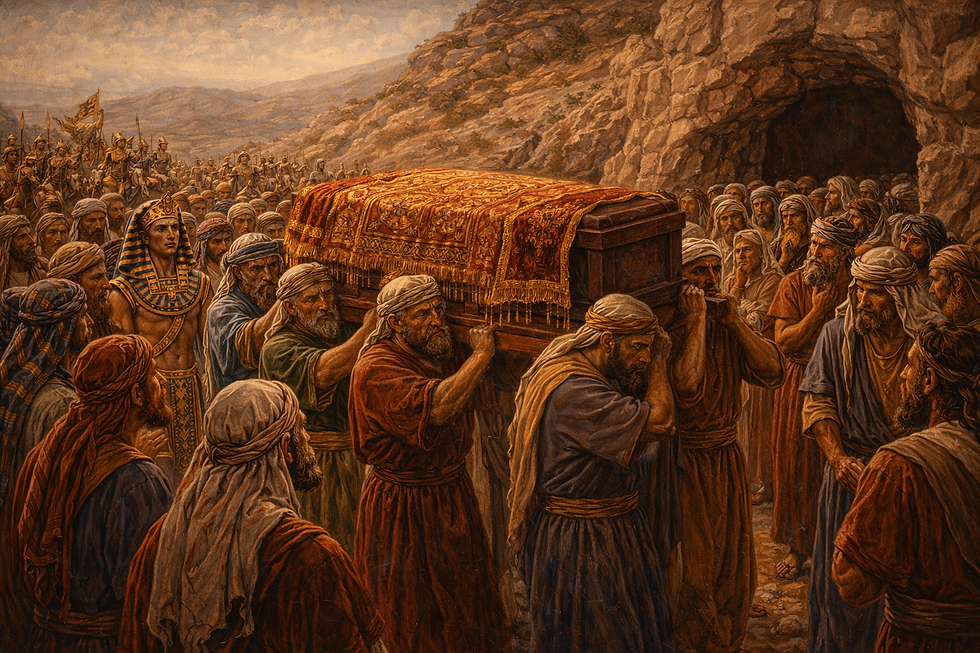
Genesis 50 focuses on three major events: Jacob’s burial, Joseph’s reassurance to his brothers, and Joseph’s death. After Jacob dies, Joseph honors him with a formal burial in Canaan. Fearing revenge, Joseph’s brothers plead for mercy, but Joseph responds with grace, declaring that God used their evil intentions for good. The chapter ends with Joseph’s death in Egypt, holding onto faith that God will one day bring Israel back to the Promised Land.
Key Themes
1. God’s Sovereignty Over Evil
Joseph’s statement in verse 20 is one of the clearest declarations of God’s control: what humans intend for harm, God can use for good.
2. Forgiveness and Grace
Joseph models Christ-like forgiveness by comforting the very brothers who betrayed him.
3. Faith in God’s Promises
Even at death, Joseph trusts that God will fulfill His covenant with Abraham.
4. The End That Points Forward
Genesis does not end in fulfillment, but in expectation. God’s promises are still unfolding.
Genesis 50 Explained: Verse-by-Verse Breakdown
Verses 1–14 - Jacob’s Burial
Joseph mourns deeply for his father, showing genuine love and honor. He requests permission from Pharaoh to bury Jacob in Canaan, fulfilling Jacob’s final wish.
This burial is significant. It reflects faith in God’s promise of the land. Jacob is not buried in Egypt, but in the land God promised to his descendants.
Verses 15–21 - Joseph Forgives His Brothers
After Jacob’s death, Joseph’s brothers fear retaliation. They assume Joseph’s kindness may have been conditional.
Joseph’s response is profound: “Am I in the place of God?” (v.19)
He recognizes that judgment belongs to God, not man.
Then comes the key verse: “You meant evil against me, but God meant it for good” (v.20)
Joseph reframes his entire suffering through God’s purpose. This is not denial of evil, but recognition of divine redemption.
He reassures them with kindness, speaking comfort instead of condemnation.
Verses 22–26 - Joseph’s Death
Joseph lives to see multiple generations. Before dying, he expresses confidence that God will visit His people and bring them out of Egypt.
He makes the Israelites swear to carry his bones back to the Promised Land. This shows enduring faith in God’s covenant.
The chapter ends with Joseph placed in a coffin in Egypt, a symbolic pause before the story continues in Exodus.
Deep Insight
Genesis 50 reveals one of the Bible’s most important truths: God’s sovereignty does not eliminate human responsibility, but it overrides human evil for His purposes.
Joseph’s life is a living testimony of Romans 8:28 before it was written. Betrayal, slavery, false accusation, and imprisonment were not random. God was orchestrating salvation not only for Joseph, but for many people.
This chapter also shifts the focus from individuals to a nation. The story is no longer just about Joseph, but about Israel’s future.
Tough Questions Answered
What does "you meant evil against me, but God meant it for good" teach about suffering?
It is one of the clearest statements in Scripture of God's sovereignty over evil for redemptive good. Joseph does not deny that his brothers genuinely intended harm; he names their evil plainly. Yet he affirms that God was working through that very evil to accomplish a saving purpose, the preservation of many lives during famine. This does not make evil good, but it means God can overrule it for good without being the author of the sin. It offers profound comfort to suffering believers: God is never absent from our pain and can weave even deliberate wrongs into His good plan, as He supremely did at the cross.
See also: Genesis 50:20, Romans 8:28, Acts 2:23
Why did Joseph insist his bones be carried back to the Promised Land?
Because Joseph believed God's promise that Israel would one day leave Egypt for the land of Canaan, and he wanted his remains to share in that future. Though he had lived and ruled in Egypt for decades, he made the Israelites swear to carry his bones up when God brought them out, an act of faith looking forward to the Exodus that would happen generations later. Hebrews praises this as an example of faith. It shows that Joseph's hope rested in God's covenant promises beyond his own lifetime, and his bones were indeed carried out in the Exodus and buried in the land, testifying that God keeps His word.
See also: Genesis 50:24-25, Exodus 13:19, Hebrews 11:22
Application (Real Life)
1. Trust God in Difficult Seasons
Joseph’s story reminds us that God is working even when circumstances seem unjust.
2. Choose Forgiveness Over Bitterness
Joseph had every reason to seek revenge, yet he chose grace. This reflects the heart of God.
3. Let God Be the Judge
Joseph’s question, “Am I in the place of God?” challenges us to release control and trust God with justice.
4. Live with Future Hope
Joseph’s faith in God’s promises encourages believers to look beyond present circumstances.
Apologetics Angle
Genesis 50 strongly supports the doctrine of God’s sovereignty. It shows that God is actively involved in human history, guiding outcomes without violating human free will.
Joseph’s role also foreshadows Jesus Christ:
Both were rejected by their own people
Both suffered unjustly
Both became instruments of salvation
Joseph’s forgiveness mirrors Christ’s words in Luke 23:34, where Jesus asks the Father to forgive those who crucified Him.
This chapter also aligns with the broader biblical narrative of redemption, pointing toward the ultimate good God brings through the cross.
Cross References
Romans 8:28 - God works all things together for good for those who love Him
Genesis 45:5 - Joseph earlier acknowledges God sent him ahead to preserve life
Hebrews 11:22 - Joseph’s faith in God’s future deliverance is commended
Luke 23:34 - Jesus demonstrates ultimate forgiveness on the cross
Deuteronomy 32:35 - Vengeance belongs to God
Exodus 13:19 - Moses fulfills Joseph’s request to carry his bones out of Egypt
Genesis 50 Explained: Conclusion
Genesis 50 explained shows that the end of Genesis is not really an ending, but a transition. God’s promises remain active, and His plan continues beyond what we can see.
Joseph’s life closes with faith, forgiveness, and confidence in God’s sovereignty. Even in death, he looks forward to what God will do next.
The message is clear: what God starts, He will finish.


Comments