
Exodus 27 Explained - The Bronze Altar and the Courtyard
Introduction
Exodus 27 describes the bronze altar, the courtyard, and the oil for the lamp. The fire on the altar shall be kept burning, it shall not go out.
The instructions move outward to the altar of sacrifice and the courtyard surrounding the tabernacle. These elements reveal that approaching God begins with sacrifice and that His light is to burn continually.
Summary
God gives instructions for the bronze altar of burnt offering, made of acacia wood overlaid with bronze, with horns at its corners and utensils for the sacrifices. He describes the courtyard of the tabernacle, enclosed by linen hangings on posts with bronze bases, with a gate of beautiful woven material. Finally, God commands that pure olive oil be brought so the lamp can burn continually in the tent of meeting, tended by Aaron and his sons from evening to morning as a lasting statute.
Key Themes
The altar of sacrifice: Approaching God begins with atonement.
The courtyard: A defined space set apart for God.
One gate of entry: A single way into the courtyard.
The continual light: The lamp must never go out.
Ongoing devotion: A lasting statute through the generations.
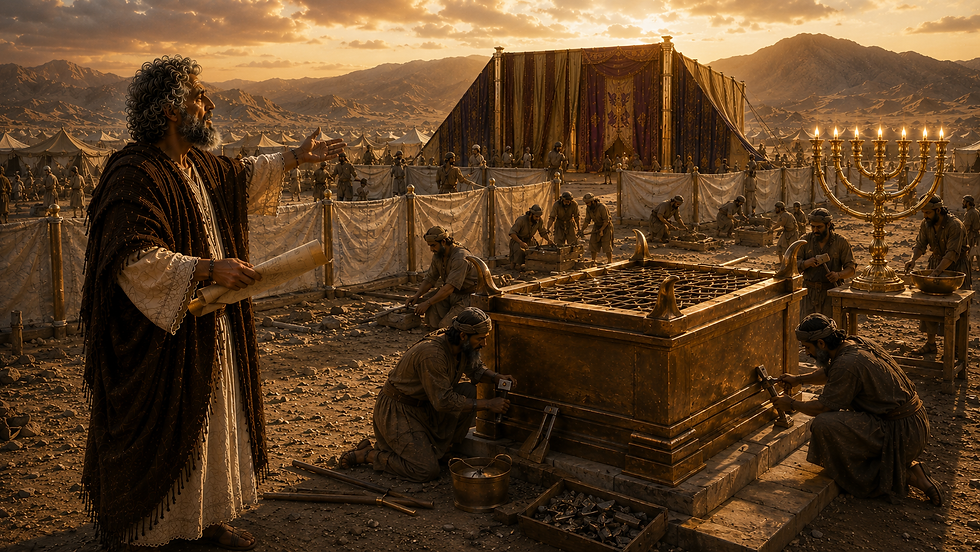
Exodus 27 Explained: Verse-by-Verse Breakdown
Verses 1-8: The Bronze Altar
The altar of burnt offering is made of acacia wood overlaid with bronze, square, with a horn at each corner and a bronze grating. Utensils of bronze, pots, shovels, basins, forks, and fire pans, accompany it. It is carried with poles and made hollow, according to the pattern shown.
Verses 9-19: The Courtyard
The courtyard is enclosed with fine linen hangings on posts set in bronze bases, with silver hooks and bands. The entrance gate is a screen of blue, purple, and scarlet yarn. All the utensils and pegs of the tabernacle are made of bronze, defining a sacred space.
Verses 20-21: The Oil for the Lamp
God commands the people to bring pure beaten olive oil for the light, so the lamp may burn continually. Aaron and his sons are to tend it in the tent of meeting from evening to morning before the Lord, a lasting statute for all generations.
Deep Insight
The layout of the tabernacle preaches the gospel in its very order. The first thing you encountered upon entering the courtyard was the bronze altar of sacrifice. You could not get closer to God's presence without first passing the place of atonement. There was no approaching the Holy God without blood, without a substitute dying in your place. This is the unchanging logic of redemption. The way to God always runs through sacrifice. For us, that sacrifice is Christ. The altar at the entrance points to the cross, the only doorway into the presence of a holy God.
Tough Questions Answered
Why was the altar the first thing in the courtyard?
Because atonement must come before access. No one could approach God's presence without first dealing with sin through sacrifice. It teaches that the way to God always runs through atonement, fulfilled in Christ. (Exodus 27:1-2, Hebrews 9:22)
Why must the lamp burn continually?
The continual light symbolized God's unceasing presence and the ongoing worship of His people. It points to Christ, the light of the world, and to believers called to let their light shine. (Exodus 27:20, John 8:12)
What is the significance of one gate?
The single entrance into the courtyard reflects that there is one way to approach God. This foreshadows Jesus, who said He is the door and the only way to the Father. (Exodus 27:16, John 10:9)
Application (Real Life)
Remember that approaching God begins with the sacrifice of Christ.
Enter through the one way God has provided, Jesus.
Keep the light of devotion burning continually.
Let your worship be ongoing, not occasional.
See the cross foreshadowed in the altar at the gate.
Simple test: Are you approaching God through the sacrifice of Christ, the only way in?
Apologetics Angle
Exodus 27's tabernacle layout reveals a deliberate theological structure: sacrifice first, then access, then the continual light of God's presence. This ordered design embeds the logic of atonement that the entire Bible develops and that Christ fulfills. The single gate and the altar of sacrifice both foreshadow Jesus' claims to be the only way to the Father and the once-for-all sacrifice. Such precise prefiguring within ancient worship instructions, later interpreted by the New Testament as pointing to Christ, demonstrates the coherent, intentional design woven throughout Scripture by a single divine Author.
Cross References
Hebrews 9:22 - Without shedding of blood there is no forgiveness.
John 10:9 - I am the door, whoever enters by Me will be saved.
John 8:12 - I am the light of the world.
Matthew 5:16 - Let your light shine before others.
Hebrews 10:1 - The law a shadow of the good things to come.
Exodus 27 Explained: Conclusion
Exodus 27 Explained reveals the altar, the courtyard, and the continual light. The altar of sacrifice stood at the entrance, teaching that the way to God runs through atonement. The lamp burned continually, picturing God's unceasing presence. All of it points to Christ, our sacrifice, our one door, and our light. Approach God through Him, and keep the light of devotion burning in your life.


Comments