
Exodus 26 Explained - The Tabernacle and the Dividing Veil
Introduction
Exodus 26 describes the tabernacle structure and its dividing veil. The veil shall separate for you the Holy Place from the Most Holy.
God gives the design for the tent of meeting, its curtains, frames, and coverings, and the veil that guards the Most Holy Place. Every detail teaches that a holy God dwells among sinful people, and access to Him is carefully guarded.
Summary
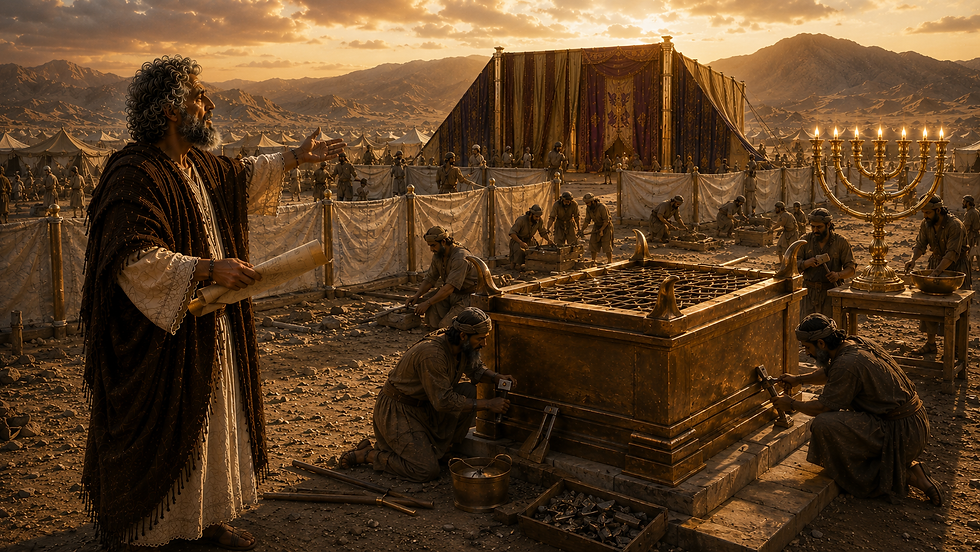
God gives detailed instructions for constructing the tabernacle: ten linen curtains with cherubim, coverings of goat hair, ram skins, and leather, upright frames of acacia wood overlaid with gold set in silver bases, and crossbars to hold them. A beautiful veil of blue, purple, and scarlet yarn separates the Holy Place from the Most Holy Place, where the ark will rest. A screen covers the entrance. Everything is made according to the pattern shown to Moses, forming the dwelling place of God among His people.
Key Themes
God's dwelling structured: Curtains, frames, and coverings.
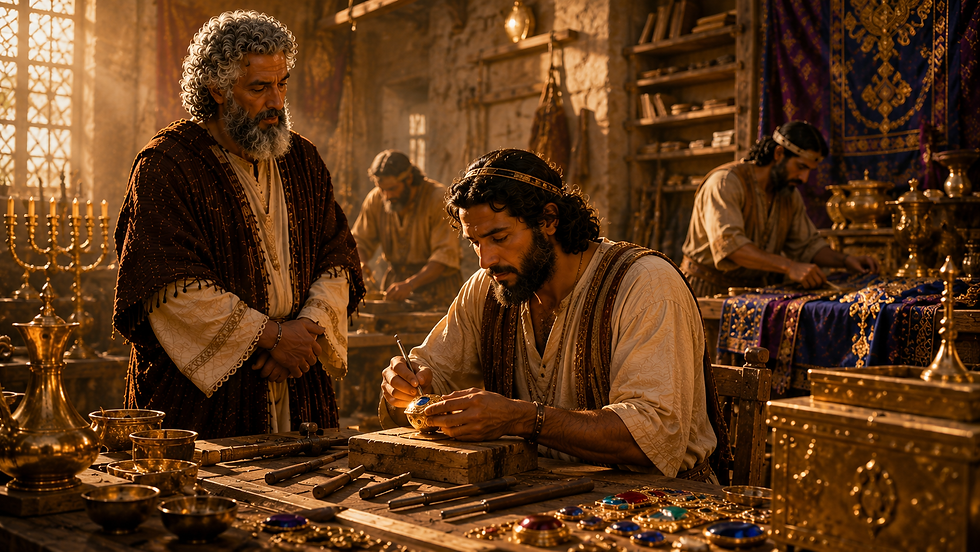
Beauty in worship: Skilled, costly craftsmanship.
The dividing veil: Separating the Holy from the Most Holy.
Guarded access: A holy God cannot be casually approached.
According to the pattern: Built exactly as God commanded.

Exodus 26 Explained: Verse-by-Verse Breakdown
Verses 1-14: The Curtains and Coverings
The tabernacle is made of ten curtains of fine linen with blue, purple, and scarlet yarn and cherubim worked into them, joined by loops and golden clasps. Over these go curtains of goat hair, then a covering of ram skins dyed red and a covering of fine leather, protecting the sacred tent.
Verses 15-30: The Frames and Bases
Upright frames of acacia wood overlaid with gold form the structure, set into silver bases, held together by crossbars overlaid with gold. The tabernacle is to be erected according to the plan shown to Moses on the mountain.
Verses 31-37: The Veil and the Screen
A veil of blue, purple, and scarlet yarn with cherubim hangs on four pillars, separating the Holy Place from the Most Holy Place, where the ark of the testimony is placed behind it. A screen of similar material hangs at the entrance of the tent.
Deep Insight
The veil is the most theologically loaded part of this chapter. It separated the Most Holy Place, where God's presence dwelt, from everyone except the high priest, who could enter only once a year with blood. The veil shouted one message: access to God is restricted, because He is holy and we are sinful. Then, at the moment Jesus died, the temple veil was torn from top to bottom. The book of Hebrews says Christ opened a new and living way through the veil, His flesh. What Sinai's veil kept closed, the cross threw open. We now draw near with confidence because of Jesus.
Tough Questions Answered
Why was the veil so important?
It guarded the Most Holy Place, teaching that sinful people cannot freely approach a holy God. Its tearing at Christ's death signaled that the way to God is now open through Him. (Exodus 26:33, Matthew 27:51)
Why such emphasis on beauty and costly materials?
The beauty reflected the glory and worth of the God who dwelt there. Worship was to be offered with the best, honoring God's majesty. Excellence in worship expresses reverence for who He is. (Exodus 26:1, Psalm 96:9)
Does the tabernacle structure have deeper meaning?
Yes. Hebrews presents it as a shadow of heavenly realities and of Christ. The layout, materials, and veil all point forward to the access to God that Jesus would secure through His death and resurrection. (Exodus 26:30, Hebrews 9:23-24)
Application (Real Life)
Remember the holiness that once kept sinners from God's presence.
Thank Christ for tearing the veil and opening the way.
Draw near to God with confidence through Jesus.
Offer God your best in worship, reflecting His worth.
Approach God's presence with both confidence and reverence.
Simple test: Are you drawing near to God through the open way Christ secured?
Apologetics Angle
Exodus 26's veil takes on profound significance when paired with the Gospel accounts that the temple veil tore from top to bottom at the moment Jesus died. This dramatic, historically attested event symbolized that the barrier between God and humanity was removed through Christ's sacrifice. The detailed tabernacle design, written centuries earlier, finds its meaning fulfilled in that single moment. This kind of long-range foreshadowing, with physical objects prefiguring spiritual realities accomplished in Christ, points to an intentional divine design spanning the entire biblical narrative.
Cross References
Matthew 27:51 - The temple veil torn in two.
Hebrews 10:19-20 - A new and living way through the veil.
Hebrews 9:23-24 - Copies of the heavenly things.
Psalm 96:9 - Worship the Lord in the splendor of holiness.
Ephesians 2:18 - Through Christ we have access to the Father.
Exodus 26 Explained: Conclusion
Exodus 26 Explained details the tabernacle and the veil that guarded God's presence. The structure was beautiful and costly, and the veil declared that access to a holy God was restricted. But when Christ died, the veil was torn, opening the way to God forever. Draw near with confidence through Jesus, who became the living way, and worship the holy God who now welcomes you into His presence.

Comments