
Revelation 18 Explained - The Fall of Babylon, the World's Mourning, and Heaven's Rejoicing
Updated: Jun 7
Summary
In the Revelation 18 explained article we are going to see how Revelation describes the fall of Babylon the Great in vivid detail. Kings, merchants, and sea captains mourn the loss of the city and its economic power. Heaven is called to rejoice over her fall. The chapter is both a lament and a triumph. It is a portrait of the total collapse of the world system built on pride, luxury, and the blood of God's people. God's people are commanded to come out of her. Her judgment comes suddenly, completely, and finally.
Key Themes
The total, sudden collapse of the world's economic and spiritual system
The call to God's people: come out of her
Mourning from those who profited from Babylon
Rejoicing from heaven as justice is served
The contrast between Babylon's self-exaltation and God's judgment

Revelation 18 Explained: Verse-by-Verse Breakdown
Verses 1-3 - Babylon Has Fallen
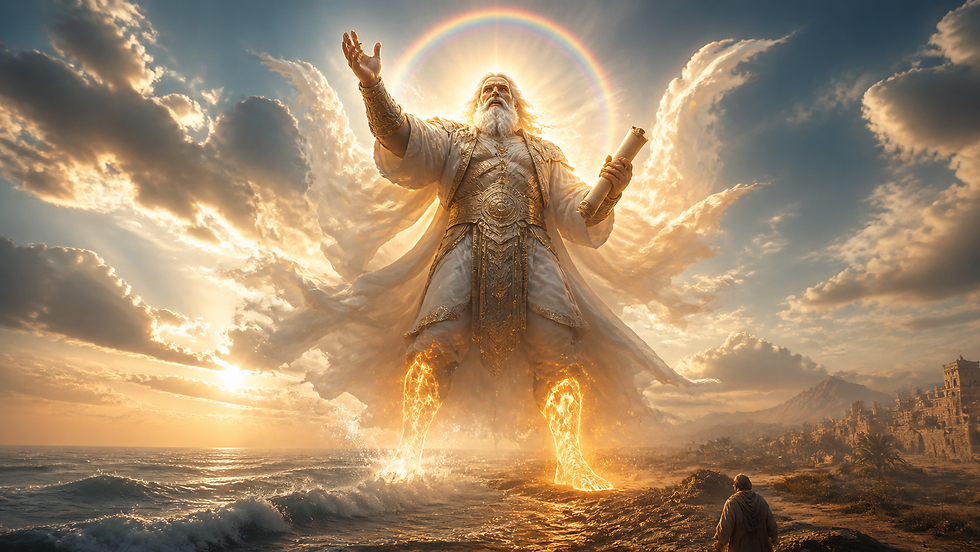
A mighty angel descends with great authority and the earth is illuminated by his splendor. He cries out: fallen, fallen is Babylon the Great. She has become a dwelling for demons and a haunt for every impure spirit. All the nations drank the wine of her adulteries. The kings of the earth committed adultery with her. The merchants of the earth grew rich from her excessive luxuries. The announcement echoes Revelation 14:8. What was declared in advance is now executed.
Verses 4-8 - The Call to Come Out
A voice from heaven warns: come out of her, my people, so that you will not share in her sins or receive any of her plagues. Her sins are piled up to heaven. God has remembered her crimes. Give back to her as she has given. Repay her double for what she has done. She said in her heart: I sit enthroned as queen. I am not a widow. I will never mourn. That pride is her indictment. Her plagues come in one day: death, mourning, famine, and fire. The God who judges her is mighty.
Verses 9-19 - Three Groups Mourn
Three groups mourn Babylon's fall. The kings weep and cry: woe, woe to you, great city, you mighty city of Babylon. In one hour your doom has come. They stand far off, terrified. Their mourning is not grief for Babylon. It is grief for what they have lost. The merchants weep because no one buys their cargoes anymore. John lists luxury goods in detail, ending with human beings, that is, human souls. The inclusion of human trafficking in Babylon's cargo list is not subtle. The sea captains and sailors throw dust on their heads and weep: in one hour she has been brought to ruin. Three groups. Three spheres of the world system. All equally devastated. All mourning their loss, not their sin.
Verses 20-24 - Heaven Rejoices
Heaven is commanded to rejoice over her fall. God has judged her with the judgment she imposed on the saints. A mighty angel picks up a boulder the size of a millstone and throws it into the sea: with such violence the great city of Babylon will be thrown down, never to be found again. No music. No craftsmen. No light. No voices of bride and groom. Total, permanent silence. In her was found the blood of prophets and of God's holy people, of all who have been slaughtered on the earth.
Deep Insight
The cargo list in verses 12-13 ends with human beings, that is, human souls. This is not accidental. Babylon's entire economy, luxury, trade, power, was built on the exploitation of human lives. Every empire that has ever trafficked in human life for profit is Babylon in spirit. The blood of the marginalized and enslaved is never forgotten in God's economy. He reads the whole list, all the way to the bottom, and the last item is what brings his judgment down. God always reads to the end of the list.
Tough Questions Answered
What does come out of her mean practically?
It is a call to spiritual and moral separation, not necessarily physical relocation. It mirrors God's call to Israel not to adopt the practices of surrounding nations. Christians are to be in the world but not of it (John 17:15-16). Practically: do not build your identity, security, or values on the world's economic and cultural system. Hold lightly to what Babylon offers, because in one hour, all of it goes.
Is Babylon's fall literal or symbolic?
Both. The imagery depicts a real economic and political collapse. Trading routes shut, markets destroyed, cities ruined. The spiritual dimension, false religion, pride, exploitation, is equally real. The one hour language emphasizes suddenness and completeness, not a specific 60-minute window.
Should Christians rejoice at the destruction of Babylon?
Heaven is commanded to rejoice, and the reason is justice for the blood of prophets and saints. This is not gloating over suffering. It is the vindication of every martyr, every exploited person, every voice silenced by the system. Rejoicing in God's justice is appropriate. The call to come out in verse 4 presupposes that people can still escape before the end. The invitation was real. The door was open. The rejoicing comes after it closes.
Application (Real Life)
Come out of her is a daily call. Examine what you are entangled with that belongs to Babylon.
Your economic security is not in the system. It is in the God who outlasts every system.
Luxury is not evil. Luxury built on exploitation always carries Babylon's bill.
The world's mourning at Babylon's fall is not love for her. It is loss of what she provided. Do not mistake the world's values for friendship.
Heaven rejoices at justice. Let that shape how you think about God's judgment rather than fearing it.
Test question: What are you holding onto from the world's system that you would grieve to lose more than you would grieve to lose Christ?
Apologetics Angle
Revelation 18 describes an economic system built on luxury, exploitation, and the trade of human souls, and declares its certain destruction. Critics sometimes accuse Christianity of being complicit in economic exploitation throughout history. But Revelation 18 is one of the most scathing indictments of exploitative economic systems ever written. The inclusion of human trafficking in Babylon's cargo list is not subtle. God sees the bottom line of every empire. Christianity, rightly understood, has always stood on the side of the exploited. The church has failed at this at times. Babylon never does. She is always faithful to her own destruction.
Cross References
Ezekiel 26-27 - The lament over Tyre, the literary model for Revelation 18
Isaiah 13:19-22 - Babylon's desolation foretold
Jeremiah 51:6, 45 - Flee from Babylon, come out of her my people
John 17:15-16 - In the world but not of the world
Amos 8:4-7 - God's judgment on those who exploit the poor
Revelation 18 Explained: Conclusion
Revelation 18 ends with silence. No music. No craftsmen. No light. No voices. Just a millstone sinking to the bottom of the sea and the echo of everything built without God, gone. The world mourns. Heaven rejoices. The contrast is everything. Those who built their lives on Babylon weep in one hour what they lived for. Those who came out of her worship in eternity what they died for. There is still time to come out. There is still time to choose the Lamb over the beast, the eternal city over the fallen one. One hour is coming. Come out now.


Comments