
Revelation 13 Explained – The Rise of the Beast and the Mark
Introduction
Revelation 13 is one of the most intense and debated chapters in the Bible. It describes two beasts, global deception, and the infamous “mark of the beast.” This chapter continues the vision that began in Revelation 12, showing how evil operates in the world through political power, false religion, and spiritual deception.
If you’re searching for Revelation 13 explained, the goal here is simple: make the message clear without speculation, while staying faithful to Scripture. This chapter is not meant to cause fear, but to prepare believers to remain faithful in a world of pressure and deception.
Summary
Revelation 13 introduces two beasts:
The first beast rises from the sea, representing a powerful, global political authority opposed to God
The second beast rises from the earth, promoting worship of the first beast through deception
The world is led into false worship
A system is established requiring a mark to buy or sell
The number 666 is associated with the beast
The chapter emphasizes endurance and faithfulness for believers living under pressure.
Key Themes
1. Satan’s Counterfeit Kingdom
Just as God (Father, Son, Holy Spirit) has authority – Revelation 13 shows a counterfeit:
Dragon (Satan) gives power
First beast Anti-Christ (likely a political power)
Second beast False Prophet (Religious like figure)
This is imitation, not originality. Evil mimics truth to deceive.
2. Political Power Used for Evil
The first beast represents a kingdom or ruler empowered by Satan. It blasphemes God and demands worship.
This echoes Daniel 7, where beasts symbolize empires. Revelation builds on that imagery.
3. Religious Deception
The second beast performs signs and convinces people to worship the first beast.
This shows that deception is not always obvious evil. It can look spiritual, persuasive, even miraculous.
4. Pressure to Conform
The “mark of the beast” represents allegiance. It is tied to economic participation.
The issue is not just a mark, but loyalty and worship.
Revelation 13 Explained: Verse-by-Verse Breakdown
Revelation 13:1-4 – The First Beast (Anti-Christ)
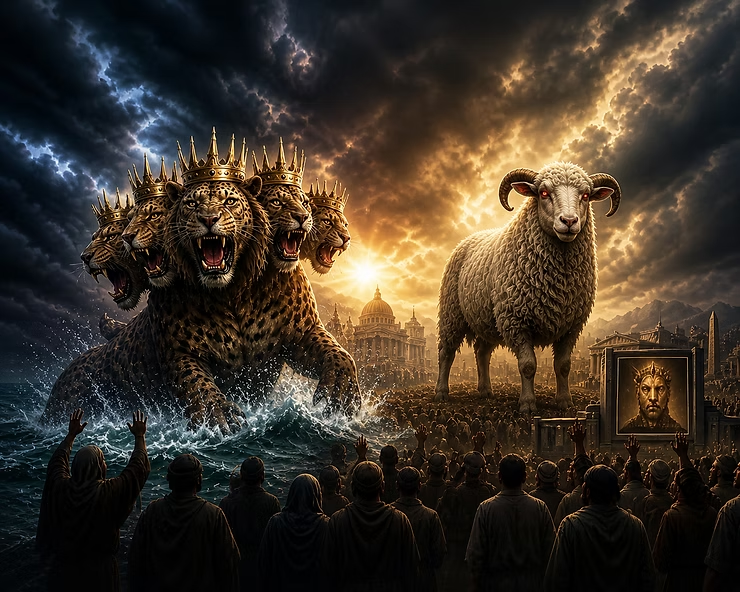
A beast rises from the sea with great authority given by the dragon. It resembles multiple animals, connecting to Daniel’s visions.
The world is amazed and begins to worship both the beast and the dragon.
Revelation 13:5-10 – Authority and Persecution
The beast speaks against God and is allowed to act for a limited time (42 months).
It wages war against believers.
Key point: God allows this temporarily. Evil has limits.
Verse 10 calls for endurance and faith.
Revelation 13:11-15 – The Second Beast (False Prophet)
This beast appears more gentle but speaks like a dragon.
It performs signs and leads people into worship of the first beast, even animating an image of it.
This highlights how deception can appear harmless at first.
Revelation 13:16-18 – The Mark of the Beast
People receive a mark on their hand or forehead to participate in buying and selling.
The number 666 is introduced.
This number likely symbolizes human imperfection or rebellion, falling short of God’s perfection (often represented by 7).
Deep Insight
The mark is often misunderstood. There are many theories, on what the Mark is or what it could be however the primary focus of the passage is allegiance. Taking the Mark shows which side you are on.
Spiritual and literal examples throughout Scripture:
Forehead = belief
Hand = action
This suggests the mark represents commitment in thought and behavior to the beast’s system. The Mark
Compare this with Deuteronomy 6:8, where God’s commands are symbolically bound to hand and forehead. There could have been physical applications to the instruction but was is clear is the allegiance of the heart.
The contrast is clear:
God marks His people (Revelation 7)
The beast marks its followers
Everyone belongs to one or the other.
Tough Questions Answered
1. Is the Mark of the beast a literal physical mark?
It may be literal, symbolic, or both. The text emphasizes allegiance more than mechanics.
2 Thessalonians 2:9-10 shows deception tied to false signs, not just physical control.
Similar to the comments above, the Mark will show true Heart Posture of the individual.
2. Why would God allow such deception?
God allows people to follow what they choose when they reject truth.
Romans 1:24-25 shows God giving people over to their desires
2 Thessalonians 2:11 speaks of strong delusion for those who reject truth
This is both judgment and consequence.
Application (Real Life)
Revelation 13 is not just about the future. It speaks to the present:
Stay grounded in the Word of God, not signs or trends
Do not confuse influence with authority from God
Be willing to stand firm even under pressure
Faithfulness matters more than comfort.
Apologetics Angle
This chapter supports key Christian truths:
Jesus is the true King, unlike counterfeit rulers
Spiritual deception is real, not imaginary
History shows repeated patterns of oppressive systems demanding loyalty
The consistency between Daniel and Revelation strengthens the Bible’s reliability across centuries.
Cross References
Daniel 7 – Beasts representing kingdoms, foundation for Revelation imagery
2 Thessalonians 2:3-12 – The man of lawlessness and deception
Deuteronomy 6:8 – Symbolic marking of God’s law on hand and forehead
Revelation 7:3 – God seals His people
Matthew 24:24 – False signs and wonders deceive many
Romans 1:24–25 – God gives people over to rejected truth
Revelation 13 Explained: Conclusion
Revelation 13 reveals how evil operates through power, deception, and pressure. It warns believers not to be naive, but also not to fear.
The message is simple and urgent:
Stay faithful.
Stay discerning.
Do not give your allegiance to anything that replaces God.
In the end, the beast’s authority is temporary, but God’s kingdom is eternal.


Comments