
Hebrews 11 Explained - The Hall of Faith and Living on God's Promises
Introduction
Hebrews 11 is the Hall of Faith. It is a roll call of ordinary people who trusted an extraordinary God.
They did not see the promise fulfilled in their lifetime. They believed anyway. This chapter defines faith, then proves it with story after story. Real faith is not a feeling. It is trust that acts.
Summary
The chapter opens with a definition of faith, then walks through the heroes of the Old Testament who lived by it. Abel, Enoch, Noah, Abraham, Sarah, Isaac, Jacob, Joseph, Moses, and more. Each trusted God's promise before they saw it. Many died without receiving what was promised, yet they were commended for their faith. They were looking ahead to a better country and a city built by God.
Key Themes
Faith defined: Assurance of things hoped for, conviction of things not seen.
Faith acts: Every example obeyed before they saw the result.
Faith endures: Many suffered and still trusted.
Faith looks ahead: They lived for a promise beyond this life.
God is faithful: He rewards those who seek Him.
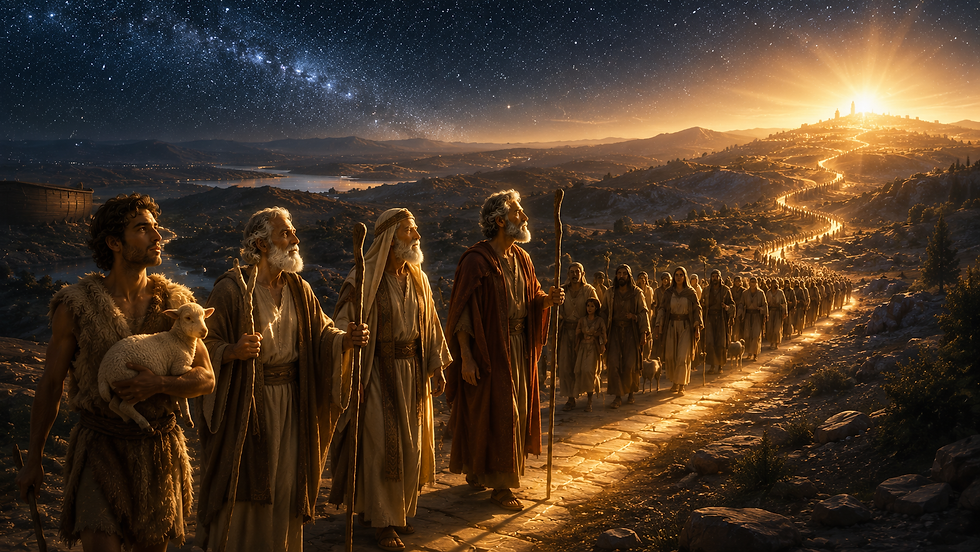
Hebrews 11 Explained: Verse-by-Verse Breakdown
Verses 1-3: What Faith Is
Faith is the assurance of what we hope for and the conviction of what we cannot see. By faith we understand that God created everything by His word. Faith is not blind. It rests on the character of God.
Verses 4-7: Abel, Enoch, and Noah
Abel offered a better sacrifice. Enoch walked with God and was taken. Noah built an ark for a flood he had never seen. Without faith it is impossible to please God, for whoever comes to Him must believe that He exists and rewards those who seek Him.
Verses 8-22: Abraham and the Patriarchs
Abraham obeyed and went out, not knowing where he was going. He lived as a stranger in the promised land, looking for a city with foundations whose builder is God. Sarah received power to conceive. Abraham offered Isaac, trusting God could raise the dead. The promise passed through Isaac, Jacob, and Joseph.
Verses 23-31: Moses and the Exodus
Moses chose to suffer with God's people rather than enjoy the fleeting pleasures of Egypt. He left Egypt by faith, kept the Passover, and passed through the Red Sea. By faith the walls of Jericho fell and Rahab was spared.
Verses 32-40: The Triumphs and the Sufferings
Time fails to tell of Gideon, David, Samuel, and the prophets. Some conquered kingdoms. Others were tortured, mocked, and killed. The world was not worthy of them. Yet none received the full promise, because God planned something better, to be made perfect together with us.
Deep Insight
Look at verses 35 to 38. Faith does not always mean rescue. Some were delivered. Others were sawn in two. Both lists appear under the same heading: by faith. We often define faith as the thing that gets us out of trouble. Hebrews defines it as the thing that holds us when trouble does not lift. The reward was never mainly in this life. It was the city God is building.
Tough Questions Answered
Is faith just believing without evidence?
No. Biblical faith is trust grounded in God's proven character and past acts. These heroes trusted because God had spoken and kept His word before. Faith is reasonable confidence, not a leap in the dark. (Hebrews 11:11, Romans 4:20-21)
Why were faithful people not rescued from suffering?
Because the promise points beyond this life. God's plan was to perfect them together with all believers in the resurrection. Earthly outcome is not the measure of faith. (Hebrews 11:39-40, 2 Corinthians 4:17)
How could flawed people like Jacob and Rahab make this list?
Because the list honors faith, not perfection. God commends imperfect people who trusted Him, which is good news for every believer. (Hebrews 11:31, Romans 4:5)
Application (Real Life)
Obey God's next step even when you cannot see the whole path.
Measure success by faithfulness, not by comfort.
Trust God's promises that reach beyond this life.
Let the failures in your past not disqualify your faith today.
Live as a citizen of the city God is building.
Simple test: Is your faith tied to getting what you want, or to trusting who God is?
Apologetics Angle
Hebrews 11 grounds faith in history, not myth. It names real people in real places who staked their lives on God's word. The honesty is striking. It includes the tortured and the killed alongside the victorious, refusing to sell an easy religion. A faith willing to record its martyrs and still call God faithful is not the product of wishful thinking. It is the testimony of people convinced by what God had actually done, looking forward to what He promised to do.
Cross References
Genesis 15:6 - Abraham believed God and it was counted as righteousness.
Romans 4:20-21 - Fully convinced God could do what He promised.
2 Corinthians 5:7 - We walk by faith, not by sight.
Hebrews 12:1 - Surrounded by so great a cloud of witnesses.
James 2:21-23 - Abraham's faith shown by his works.
Hebrews 11 Explained: Conclusion
Hebrews 11 Explained is a gallery of people who trusted God before they saw the proof. They obeyed, endured, and looked ahead to a better country. Their God is your God. The same faith that carried them can carry you. Fix your eyes on the promise, and walk.


Comments