
Genesis 18 Explained - The Lord Appears to Abraham
Updated: Jun 7
Introduction
Genesis 18 explained brings us into a deeply personal moment where God visits Abraham, reaffirms His promise of a son, and reveals His plan concerning Sodom and Gomorrah. This chapter blends intimacy with divine justice, showing both God’s mercy and His righteousness. It also highlights Abraham’s role as an intercessor, pointing forward to greater spiritual truths.
Summary
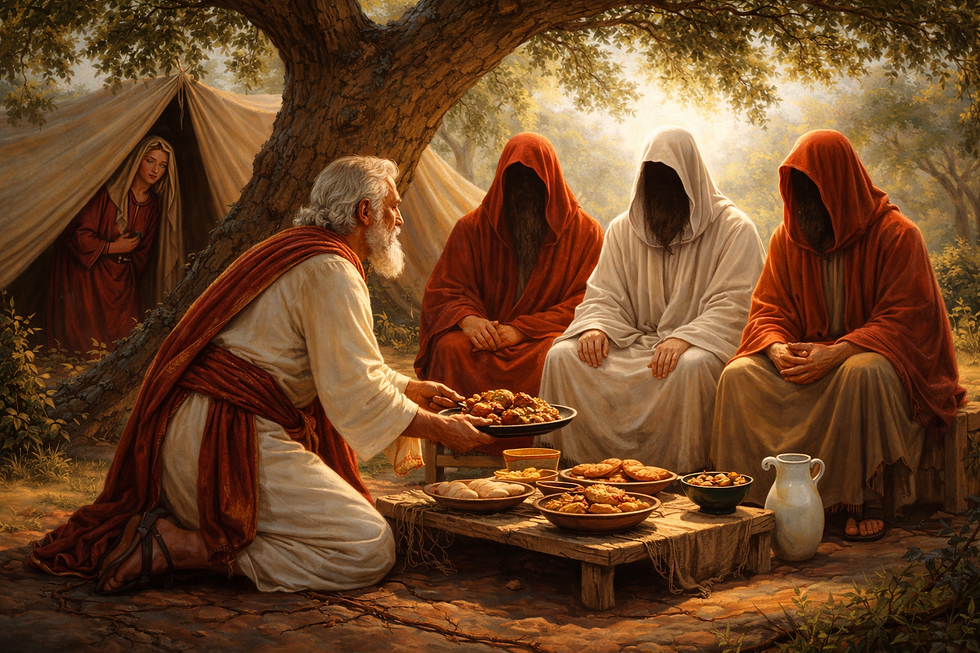
In Genesis 18, the Lord appears to Abraham near the oaks of Mamre in the form of three visitors. Abraham shows generous hospitality. During the visit, God promises that Sarah will have a son within a year, causing her to laugh in disbelief. The Lord then reveals His intention to judge Sodom and Gomorrah due to their great wickedness. Abraham intercedes, asking God to spare the city if righteous people can be found. God agrees, showing His willingness to respond to righteous appeal.
Key Themes
1. God’s Nearness
God does not remain distant. He comes near and engages personally with Abraham.
2. Faith vs Doubt
Sarah laughs in doubt, yet God remains faithful to His promise.
3. Divine Justice and Mercy
God judges sin but is willing to spare for the sake of the righteous.
4. Intercession
Abraham stands in the gap, pleading on behalf of others.
Genesis 18 Explained: Verse-by-Verse Breakdown
Verses 1-8 The Lord appears as three men. Abraham offers food, rest, and honor, demonstrating humility and hospitality.
Verses 9-10 God reiterates the promise: Sarah will have a son within a year.
Verses 11-12 Sarah laughs inwardly, doubting because of her old age.
Verses 13-15 God confronts her doubt: “Is anything too hard for the Lord?” Sarah denies laughing, but God knows the truth.
Verses 16-21 The men look toward Sodom. God reveals His plan to Abraham, showing relational transparency.
Verses 22-26 Abraham begins interceding, asking if the city will be spared for 50 righteous people.
Verses 27-32 Abraham continues, humbly lowering the number to 10. God agrees each time.
Verse 33 The Lord departs after the conversation.
Deep Insight
Genesis 18 reveals a powerful balance between God’s holiness and His relational nature. God invites Abraham into His plans, not because He must, but because He desires partnership.
Abraham’s intercession is significant. He appeals to God’s character:
God is just
God does what is right
This moment foreshadows the role of a mediator. Abraham stands between judgment and mercy, pointing forward to Jesus Christ, who intercedes perfectly on behalf of humanity.
Sarah’s laughter also reveals something deeper. Human doubt does not cancel divine promise. God responds not by withdrawing, but by reaffirming His power.
Tough Questions Answered
Who were the three visitors, and was one of them the Lord Himself?
The text says the Lord appeared to Abraham as three men, and as the scene unfolds one of them speaks directly as the Lord while the other two, later identified as angels, go on to Sodom. Many understand the central visitor to be a pre-incarnate appearance of God, sometimes called a theophany or a Christophany, God taking visible form before the incarnation. Abraham addresses Him as Lord and He makes divine promises and judgments. While Scripture does not exhaustively explain it, the passage shows God drawing remarkably near to His servant, sharing a meal and conversation, a foretaste of the deeper nearness God would bring in Christ.
See also: Genesis 18:1-2, Genesis 18:13-14, John 1:18
What does Abraham's bargaining over Sodom teach about God's justice and mercy?
It reveals a God who is both perfectly just and remarkably patient with intercession. Abraham boldly asks whether God would spare Sodom for fifty righteous people, then lowers the number step by step to ten, and each time God agrees. Far from being worn down, God invites the conversation, displaying His willingness to spare the wicked for the sake of the righteous. It shows that judgment is never careless, that God will not sweep away the righteous with the guilty, and that He honors intercession. It also points forward to Christ, the perfect intercessor, and ultimately to the truth that God would save the guilty through one righteous One.
See also: Genesis 18:23-32, Ezekiel 22:30, 1 Timothy 2:5
Application (Real Life)
Practice hospitality - Abraham welcomed strangers and encountered God.
Bring your questions to God - Abraham respectfully reasoned with Him.
Trust God’s power - Nothing is too hard for Him.
Intercede for others - Pray boldly for people, even in difficult situations.
Apologetics Angle
1. The Appearance of the Lord
This chapter includes a visible appearance of the Lord. Many see this as a pre-incarnate appearance of Jesus Christ, showing that God has always revealed Himself personally.
2. God’s Omniscience
God knew Sarah laughed even when she denied it, proving His all-knowing nature.
3. Justice and Mercy Together
God does not ignore sin, but He is patient and willing to spare. This balance is fully revealed in the gospel.
4. Foreshadowing Christ’s Intercession
Abraham’s role points to Jesus:
Jesus intercedes perfectly for believers
He satisfies justice while extending mercy
5. Trinity Insight
The presence of three visitors has often been discussed in relation to the Trinity. While not a full revelation, it hints at the complexity of God’s nature.
Cross References
Genesis 17:19 - God promised Isaac’s birth through Sarah
Jeremiah 32:17 - Nothing is too hard for God
Luke 1:37 - “Nothing will be impossible with God”
Hebrews 13:2 - Hospitality can entertain angels unaware
Romans 8:34 - Christ intercedes for us
James 2:23 - Abraham called a friend of God
Genesis 18 Explained: Conclusion
Genesis 18 explained shows a God who is both near and just. He keeps His promises despite human doubt and invites His people into meaningful relationship and intercession. Abraham’s bold conversation with God reveals the power of prayer, while the promise of Isaac reinforces that nothing is too hard for the Lord. Ultimately, this chapter points forward to Christ, our perfect mediator and fulfillment of God’s promises.


Comments