

Acts 18 Explained - Courage, Teamwork, and Humble Learning
Introduction
Acts 18 Explained follows Paul into Corinth, a busy port city with a bad reputation, where he sews tents by day, argues about Jesus on the Sabbath, and hears the Lord tell him not to be afraid.
Have you ever been scared to keep doing the very thing God told you to do?
Estimated timeframe: about AD 50-53. The chapter spans eighteen months in Corinth, Paul's departure from Cenchrea, his return to Antioch, and the start of another journey.
Summary
In Corinth Paul works with Aquila and Priscilla, a Jewish couple pushed out of Rome by the emperor Claudius. When the synagogue turns on him, he moves next door. The Lord tells him in a vision to keep speaking, so he stays a year and a half. The Roman governor Gallio throws out a case against him. Later, Priscilla and Aquila take a gifted preacher named Apollos home and teach him more accurately.
Key Themes
Work and witness belong together: Paul pays his own way as a tentmaker while he preaches.
God speaks to fear: The Lord's promise in 18:9-10 keeps a nervous apostle in a hard city.
Rome cannot be used to stop the gospel: Gallio refuses to treat the faith as a crime.
Ordinary couples do great work: Priscilla and Aquila open their home and their table.
Gifted teachers still learn: Apollos takes correction and becomes even more useful.
Growth takes follow-up: Paul goes back to strengthen the disciples he already has.
Acts 18 Explained: Verse-by-Verse Breakdown
Verses 1-4: Tentmakers in Corinth
Corinth was the capital of Achaia, the Roman province covering southern Greece. Paul finds "a Jew named Aquila, a native of Pontus, who had recently come from Italy with his wife Priscilla because Claudius had ordered all the Jews to leave Rome" (18:2).
That detail checks out. Suetonius, a Roman writer of emperor biographies in the early 100s, says Claudius "expelled" the Jews from Rome because they kept making disturbances at the urging of someone called "Chrestus." Many historians think that is a garbled form of "Christus," Christ.
Paul works with them because "they were tentmakers by trade, just as he was" (18:3). Think of a small business owner who still teaches Sunday school. Paul sews tents all week, and "every Sabbath he reasoned in the synagogue" (18:4).
Verses 5-11: Keep On Speaking
When Silas and Timothy arrive, Paul devotes himself full time to testifying "that Jesus is the Christ" (18:5). The synagogue pushes back hard. Paul shakes out his garments, a public sign that he is done there, and says, "From now on I will go to the Gentiles" (18:6).
He does not go far: next door, to the house of Titus Justus. And Crispus, the synagogue leader, believes with his whole household. This is a move away from one hostile synagogue, not a farewell to the Jewish people; a few verses later Paul walks straight into the synagogue at Ephesus (18:19). The larger question of whether ethnic Israel remains God's chosen people is a real one that faithful Christians study, but this verse does not answer it.
Then comes the night vision: "Do not be afraid; keep on speaking; do not be silent. For I am with you and no one will lay a hand on you, because I have many people in this city" (18:9-10). Jesus does not promise an easy city. He promises His presence, so Paul stays.
Verses 12-17: Gallio Throws Out the Case
"While Gallio was proconsul of Achaia" (18:12), the Jewish leaders bring Paul to the judgment seat. A proconsul was the governor of a province run by the Roman Senate.
The charge is that Paul teaches worship "contrary to the law" (18:13). Before Paul can speak, Gallio rules that this is "a dispute about words and names and your own law" (18:15) and drives them out. A Roman governor had just treated faith in Jesus as an argument inside Judaism, not a crime against Rome. The crowd then beats Sosthenes, the new synagogue leader, and Gallio does nothing.
Verses 18-28: A Vow, a New Journey, and Apollos
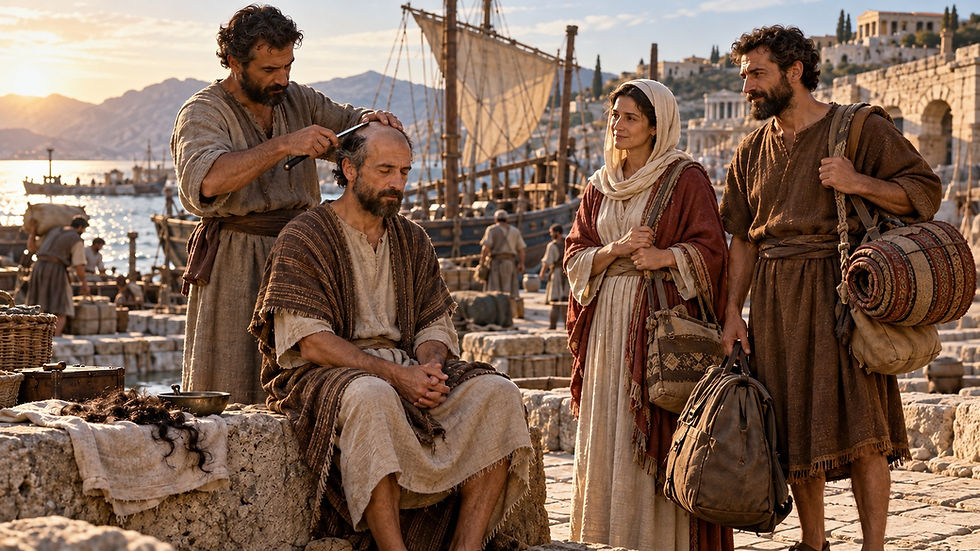
Paul "had his head shaved in Cenchrea to keep a vow he had made" (18:18). Cenchrea was Corinth's port. He stops at Ephesus, then Jerusalem and Antioch, closing his second missionary trip. Verse 23 opens the third: he travels through Galatia and Phrygia "strengthening all the disciples."
Apollos, a Jew from Alexandria in Egypt, is "an eloquent man, well versed in the Scriptures" (18:24). He teaches "accurately about Jesus, though he knew only the baptism of John" (18:25). Priscilla and Aquila "took him in and explained to him the way of God more accurately" (18:26). Instead of calling out a gifted preacher in front of the room, a working couple invites him home. Apollos goes on to Achaia, "proving from the Scriptures that Jesus is the Christ" (18:28).
Deep Insight
Why would Paul need a vision telling him not to be afraid? Writing back to this church, he tells you: "I came to you in weakness and fear, and with much trembling" (1 Corinthians 2:3). He had been beaten, chased out of two cities, and laughed at in Athens. Courage in the Bible is not the absence of fear. It is obeying God with your knees shaking because He said, "I am with you."
Tough Questions Answered
Why would Paul, who preached grace, cut his hair for a vow, and why do it at Cenchrea instead of the temple?
It looks like Paul going back to the law. He was not, and three questions show why. First, who shaved? The Greek could point to Aquila, but nearly all translations read it as Paul, the one traveling on to Jerusalem. Second, why there? The formal Nazirite vow ended at the sanctuary, with the head shaved and the hair burned under an offering (Numbers 6:18). Cutting the hair at Cenchrea fits a private vow, perhaps of thanks for the promise in 18:10, with any offering made later in Jerusalem (18:22).
Third, does it clash with grace? No. A vow was a voluntary promise to God, not a payment for salvation. Paul never told Jewish believers to stop keeping their customs; he told everyone to stop trusting them to save. And the apostles had just agreed "it is through the grace of the Lord Jesus that we are saved" (15:11). Luke does not say what kind of vow it was, but nothing here suggests Paul was earning anything.
Did Claudius really expel "all the Jews" from Rome?
A skeptic notes that Rome had tens of thousands of Jews, and Cassius Dio, a Roman historian of the early 200s, says Claudius did not drive them out but ordered them not to hold meetings.
Yes, Claudius did order Jews out of Rome, though the order was likely not enforced on every one of them. We have two Roman reports, and both say Claudius cracked down. Dio describes a ban on meetings, which he places early in Claudius's reign. Suetonius, a Roman writer with no interest in defending Christians, says Claudius expelled the Jews over disturbances tied to "Chrestus." These may be two steps years apart, or two reports of one crackdown. Luke reports what the order said, not that every last Jew left. An order like that would hit the leaders hardest and fade over time, which is why Priscilla and Aquila are back in Rome a few years later (Romans 16:3).
If Apollos knew only John's baptism, how could Luke say he taught "accurately about Jesus"?
Accurate and complete are not the same thing. Apollos had the facts about Jesus right as far as they went, but he likely missed what came later, such as Christian baptism and the Spirit poured out at Pentecost.
That is why Priscilla and Aquila taught him "more accurately," not from scratch. A teachable heart turned a good preacher into a better one.
Application (Real Life)
Do your daily work well. Your job site may be your best pulpit.
When fear tells you to go quiet, remember the promise Jesus gave Paul in the night. Paul stayed anyway.
Correct people the way Priscilla and Aquila did: at your table instead of in public, kindly, and with the Scriptures open.
If you are the one being corrected, listen. Being gifted does not mean being finished.
Apologetics Angle
One broken stone pins a date on Paul's life, and Luke's timeline fits it.
In the early 1900s, French excavators at Delphi in Greece found pieces of a letter from the emperor Claudius carved in stone. It names Gallio. Part of the stone is broken off, and the most likely way to fill the gap has Claudius calling Gallio his friend and proconsul. The letter calls Claudius "acclaimed emperor for the 26th time," and other Roman inscriptions date that count to AD 52. Since governors like Gallio usually served one year, his term in Achaia falls in about AD 51-52.
Now lay Luke's story on that date. Paul stayed in Corinth a year and a half (18:11), and Gallio's court comes during that stay. Luke gives no years at all, yet the governor he names sits in Corinth in the very years the stone puts Gallio there. A writer working from rumor decades later would be hard pressed to get the right governor in the right city at the right time by accident.
Cross References
1 Corinthians 2:1-5 - Paul came to Corinth in weakness and fear, which explains the vision of 18:9-10.
1 Corinthians 3:5-9 - Paul planted, Apollos watered, and God gave the growth in this same church.
Romans 16:3-5 - Priscilla and Aquila, back in Rome and hosting a church.
Numbers 6:13-21 - the Nazirite vow and its ending at the sanctuary, the background to Paul's vow.
Acts 19:1-7 - the next chapter meets more disciples who knew only John's baptism, just like Apollos.
Acts 18 Explained: Conclusion
Acts 18 Explained leaves a frightened preacher staying put in a hard city because Jesus told him, "I am with you." That promise came from a Lord who had already been through the worst a city could do to Him. He was crucified outside Jerusalem and rose from the grave, and He saves by grace everyone who believes in Him. A governor's name carved in stone at Delphi ties this chapter to real history. Do what Apollos did when a tentmaker couple opened the Scriptures to him: listen, learn, and let the evidence correct you where it needs to.


Comments